
Course · In preparation · Free live session first

From Managed to Hybrid. Where should your AI actually run?

Amazon Bedrock, SageMaker AI, or your own GPUs on Red Hat OpenShift AI. The course teaches the decision, not the product: what each layer costs, what you operate, where your data has to stay, and how to tell which one a use case needs before anyone starts building.

  • Free live session to start
  • English, cohort in Vienna time
  • Built from a university lecture
  • Waitlist gets the date first
Waitlist

The date goes to the waitlist before it goes public.

The first live session is free, three hours, with live questions. I am setting the date against the waitlist, so the people on it decide when it runs and what gets covered in the most depth.

  • The date and time, before the announcement
  • A say in which of the six layers gets the deep dive
  • The decision tool and the cost sheet, whether or not you attend
  • First place in the paid cohort that follows, if you want it

Double opt-in: you confirm by email first. Company and role are optional but they decide which track I build for you. Unsubscribe with one click.

Step 1 · FreeA three-hour live session: the six layers, the decision tool, and a real cost comparison. Recorded, so the replay is yours either way.
Step 2 · CohortA small paid cohort over one week, three live working sessions, on your own use case rather than a demo one.
Step 3 · Your teamThe same material delivered privately, or as a workshop against your architecture. Team pricing per seat.
Why this course exists

The platform gets picked before the constraints are written down.

Almost every stalled AI project I review made the same mistake in the same order: somebody chose a platform, then discovered the constraint that ruled it out. Data that may not leave the building. A cost per request that only works at a tenth of the volume. A compliance requirement that arrives after the prototype.

The constraint is not a surprise. It was knowable on day one. What was missing was a way to ask the question in the right order.

That order is what I teach at Hochschule Burgenland, and it is what this course is built from: six layers, from calling a ready-made capability to running your own models on your own hardware. For each layer, what you operate, what it costs, what leaves your network, and what you are signing up to keep running.

It is deliberately not an AWS course. I build on AWS and I am an AWS Community Hero, and I am also a Red Hat partner who runs OpenShift AI environments. The interesting part of this subject is exactly the comparison neither vendor can publish.

The course does not tell you which layer to pick. It tells you which question decides it, and in which order to ask.
Six layers of AI architecture from ready-made capabilities to your own models on your own hardware.
The six layers the course is built around. Each row is one level of how much of the stack you operate yourself.Source: Linda Mohamed, lecture “Von Managed zu Hybrid: KI-Architekturen”, Hochschule Burgenland, 2026
What you leave with

Working tools, not slide decks.

Everyone who attends the free session gets the first two. The cohort adds the rest, applied to your own use case.

1

The layer decision toolFree session

Five questions that suggest a layer, with the logic visible so you can argue with it. The same tool I use at the start of an architecture review.

2

The cost comparison sheetFree session

Per-token, per-hour and per-GPU costs put on one page, with the break-even point calculated rather than asserted[5].

3

A layer decision record for your use caseCohort

One page: the constraints, the layer, the reason, and what would have to change for the answer to change.

4

A reference architecture you can build fromCohort

Named down to the service, with the data boundary drawn and the failure modes listed.

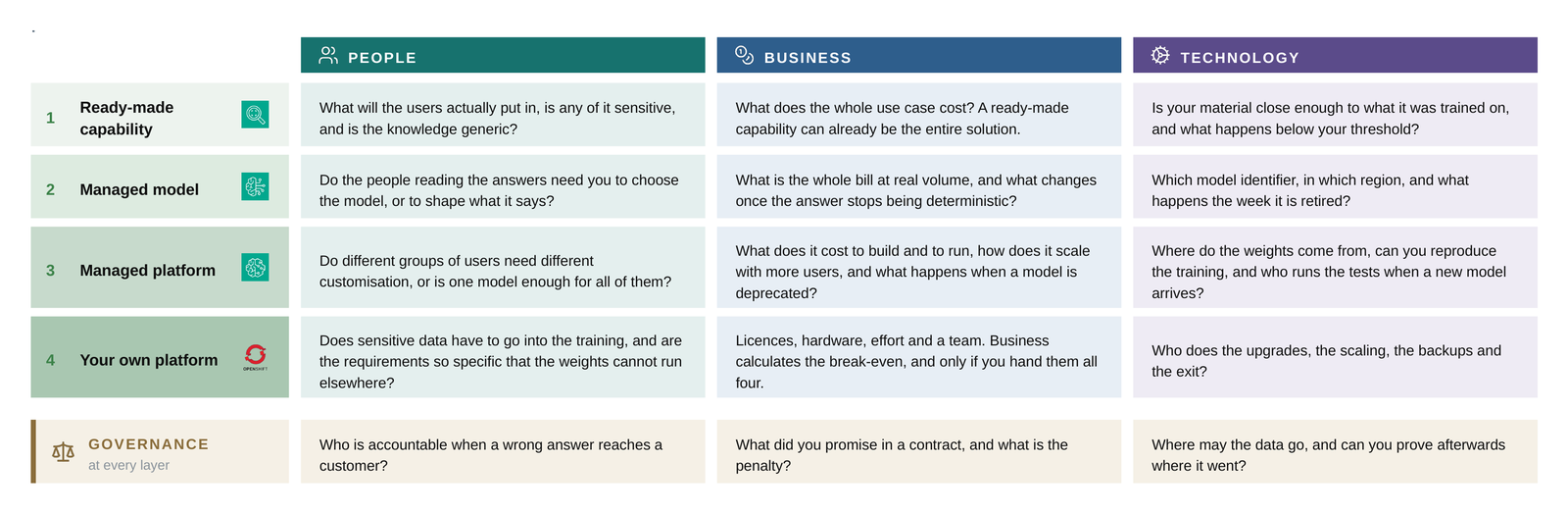
Decision grid: for each architecture layer, questions about people, business and technology, plus governance at every layer.
The decision compass used throughout: people first, then business, then technology, with governance at every layer.Source: Linda Mohamed, lecture “Von Managed zu Hybrid: KI-Architekturen”, Hochschule Burgenland, 2026
Who it is for

Three people get the most out of it.

It is a technical course, but it is not only for engineers. The decision it teaches is usually made by three people who do not normally sit in the same room.

Architects and lead engineers

You will build it

You already know the services. What this gives you is a defensible way to say no to the wrong one, with numbers attached.

Platform and operations

You will run it

The layers differ mostly in what lands on your on-call rota. This makes that explicit before the decision, not after.

Heads of data, product and engineering

You will pay for it

The cost model and the constraint list in a form you can take to a budget conversation without needing the engineer in the room.

The content

What the free session actually covers.

Three hours, live, with questions throughout. The recording goes to everyone who registers, whether or not they make it on the day.

BlockWhat we doWhat you take away
The six layersWalk the layer map with a real use case at each level, from a ready-made capability to a self-hosted model[8]The map, and the vocabulary to argue about it
The decision toolRun the five questions live against use cases from the roomA suggested layer for your own case
What it costsPer-token against per-hour against per-GPU, with the break-even calculated[9]The cost sheet, filled in
Where the data goesDraw the boundary: what crosses to a managed endpoint and what never leaves[7]A boundary drawing for your own architecture
QuestionsOpen, unscripted, as long as people keep askingThe answer to the thing you actually came for
Honestly, about the format

This is a small cohort, not a mass launch.

There are courses in this space that put ten thousand people in a webinar. That works when you have spent seven years building an audience of a million and a half. I have not, and pretending otherwise would waste your time and mine.

What I have instead is a narrow, unusual position: an AWS Community Hero who is also a Red Hat partner, teaching this as a university lecture, building it for real clients, and publishing the engineering openly on ai-solutions.wiki. That makes for a better course and a smaller room.

So the first cohort will be small, the questions will get answered properly, and the material will be shaped by what the people on the waitlist say they actually need. If you want the anonymous version, there are excellent free courses from AWS and Red Hat and I will happily point you at them.

A small room where your question gets a real answer beats a large one where it does not.
AWS services

The AWS services behind this work.

The services the course compares. Each link goes to the official documentation, not to a summary of it.

Amazon Bedrock

Managed access to foundation models from several providers through one API. You choose the model and write the prompt; AWS runs the model.

Amazon SageMaker AI

Managed platform for the whole machine learning lifecycle: notebooks, training jobs, model registry and endpoints.

Red Hat OpenShift Service on AWS (ROSA)

Managed OpenShift clusters in your AWS account. The base for running OpenShift AI next to other AWS services.

Amazon EC2 G6e instances

GPU instances with NVIDIA L40S cards for self-hosted inference, for example with vLLM.

Amazon Bedrock AgentCore

Runtime, memory, identity and tool gateway for AI agents built with any framework, such as Strands or CrewAI.

AWS Pricing Calculator

Builds a cost estimate per service before anything is deployed.

Questions

What people ask before booking.

When does it run?

The date is not fixed yet, on purpose. I am setting it against the waitlist so the session runs when the people who want it can actually attend. Everyone on the waitlist hears before it is announced anywhere else.

What does it cost?

The first live session is free. The cohort that follows is paid; the price will be in the range of a single training day, and it will be on this page before anyone is asked to commit. Team pricing is per seat.

Is it an AWS course?

No. It compares Amazon Bedrock, Amazon SageMaker AI and self-hosted models on Red Hat OpenShift AI, on AWS and on your own hardware. I am an AWS Community Hero and a Red Hat partner, which is why the comparison is possible.

Do I need to be an engineer?

You need to be comfortable with architecture diagrams and rough cost maths. You do not need to write the code. Several of the most useful questions in these sessions come from product and platform people.

Is it live or recorded?

The first session is live with open questions, and recorded. The cohort is live working sessions, deliberately, because the value is in applying it to your own case.

In English or German?

The course runs in English. The private team delivery runs in either. The university lecture this is built from is in German.

Can my company book it for a team?

Yes, and that is usually the better route. Private delivery against your own architecture, or seats in a public cohort. Tell me the team size on the waitlist form and I will come back with both options.

Linda Mohamed, AWS Community Hero, AI and cloud architect in Vienna
Who runs it

Linda Mohamed

AWS Community HeroAWS User Group Vienna organiserLecturer, Hochschule BurgenlandAmazon Bedrock · SageMaker AI · OpenShift AIEN & DE

I design and build AI and cloud systems on AWS and hybrid platforms, and I teach how they work. I have organised the AWS User Group Vienna for more than seven years, co-organise AWS Community Day DACH, teach AI architectures at Hochschule Burgenland, speak at conferences in Europe and the US, and maintain ai-solutions.wiki. Based in Vienna. Remote or on-site, in English or German.

Projects, open source and talks →

Start here

Start with one conversation.

30 minutes to look at your idea, your data and the right starting point. Or book 15 minutes if you only have a question.

  • Whether the course fits your situation
  • Which layer your use case probably needs
  • Whether a private team delivery makes more sense
  • What it would take to run it for your department

Vienna, Austria · remote across Europe · [email protected]