
Thirty minutes to find out whether a workshop is worth it
Bring one idea, one problem or one half-finished prototype. I tell you what I would do next, which workshop fits, and where I think it gets expensive. If the honest answer is that you do not need me yet, you get that too.
- Free
- 30 minutes
- Remote
- English or German
What actually happens in the half hour
Most people book this call with one of three situations: a list of AI ideas and no way to rank them, one idea that a team already started and wants a second opinion on, or a platform question such as whether to stay with managed services or run models themselves.
I ask about the problem, the data, who has to agree, and the constraints that are not negotiable. You get my read on where the risk sits and what the first useful step is. Nothing is recorded, and nothing leaves the call.
If you only have one narrow question, book the 15-minute slot instead. Same rule: an answer, not a sales script.
An idea
Is there something here?
A sentence anyone can say out loud. No architecture yet, and no budget.
Free 30-min callA scored use case
Which one first?
The shortlist, scored on value and on effort, with the reason written down. Out: a ranked list
A concept
What would it cost?
Architecture, the layer decision, and a cost model per service. Out: a price you can take to finance
A prototype
Does it work on our data?
Built on your real data, with the awkward records included. Out: measured results
A decision
Go, stop or narrow?
Written down with what would change the answer. Stopping here is a good outcome.
Decision pointProduction
Who runs it?
Built properly, operated, and owned by a named team. Out: a running service
Each rung ends with a decision, and stopping early is a valid one. Most of the money lost on AI projects is spent after the rung where someone should have stopped.
Where the call puts you on the ladder. Each rung ends with a decision, and stopping early is a valid one.Source: Linda Mohamed, AI Use Cases Workshop deck, 2026
In half an hour, four answers
Is the idea buildable?
A plain read on feasibility with today's AWS services, and what would have to be true about your data[1].
What is the right first step?
Discovery, a concept workshop, an architecture review, a prototype, or nothing yet.
What will it roughly cost?
The order of magnitude for the workshop and for the running system, so you can talk to your sponsor[3].
Could AWS funding apply?
Many proofs of concept and migrations qualify. What applies depends on the project, the programme and the AWS account team[2].
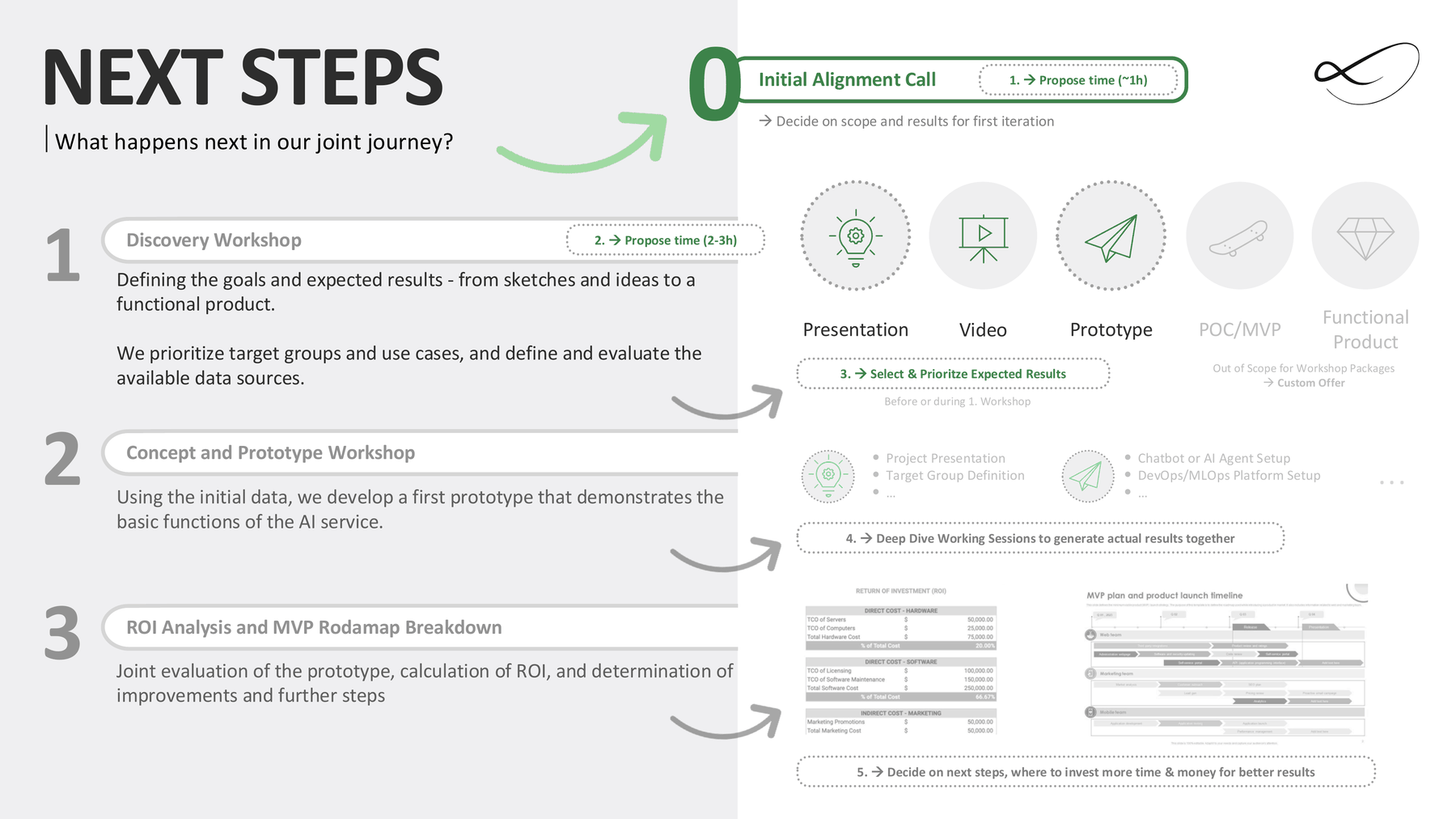
Step zero of a longer path
The call is the first rung. Nothing after it is booked until you want it.
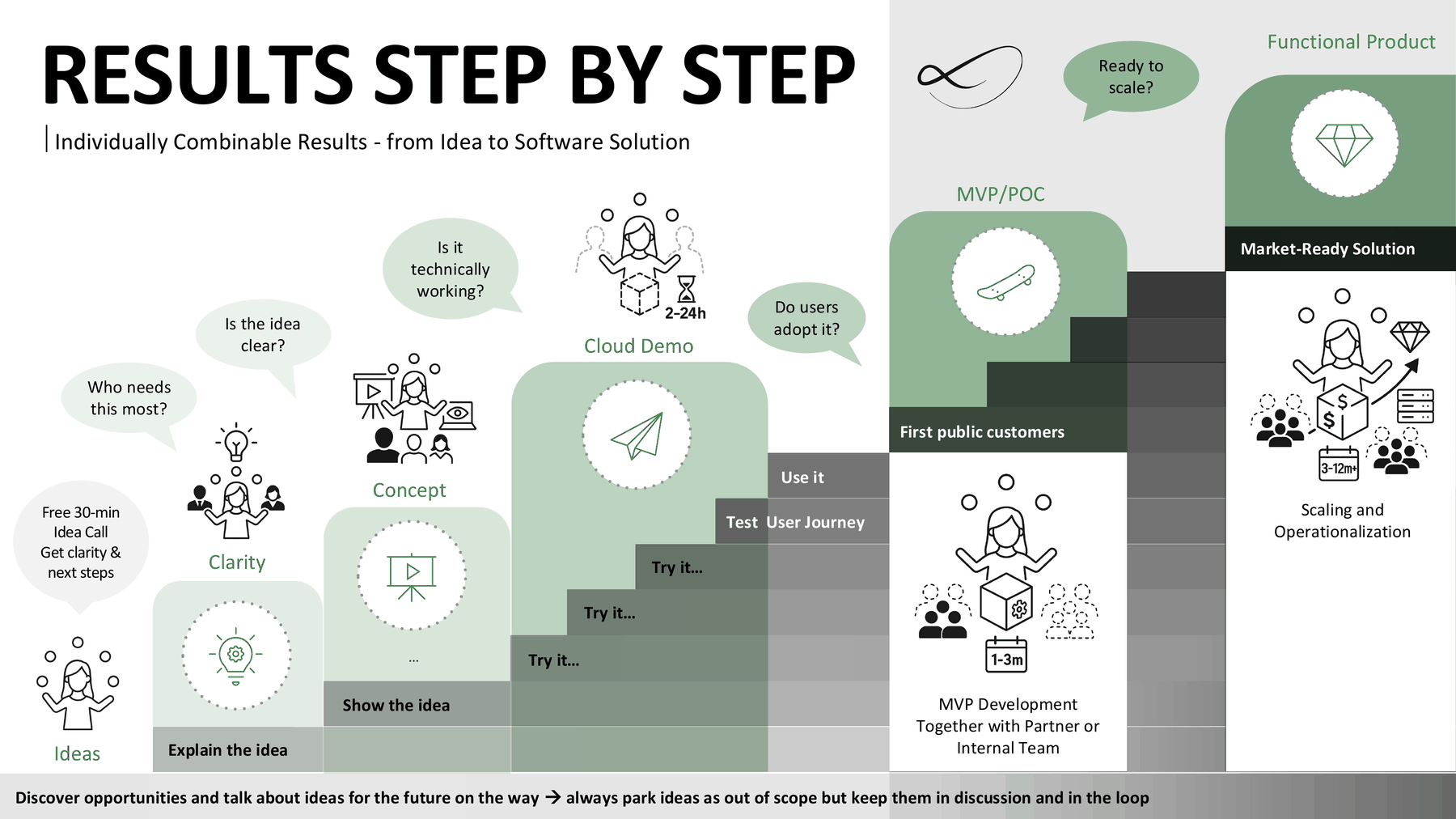
Ideas
Who needs this most?
The idea said out loud, and who it is actually for. Out: a shortlist
Free 30-min callClarity
Is the idea clear?
Written so anyone in the room can repeat it back without you. Out: one page
Concept
Is it technically working?
The idea shown, not described: data, layer and approach chosen. Out: a concept
Cloud demo
Does it survive contact?
Something real to click, running in the cloud. Out: a demo you can try
2–24 hoursMVP / POC
Do users adopt it?
First public customers on a real user journey, built with your team or a partner. Out: measured use
1–3 monthsFunctional product
Ready to scale?
Market-ready, scaled and operated, with someone on call. Out: a product
3–12 months+Ideas found on the way get parked. They stay in the discussion and out of the build, so the current step keeps its scope and nothing is quietly forgotten.
Every step answers one question and produces something you can look at or try. The call on the left costs nothing and decides whether any of the rest is worth doing.Source: Linda Mohamed, AI Use Cases Workshop deck, 2026
Ten minutes of preparation is enough
Nothing formal. These three things make the call sharper.
The problem in one sentence
Who has it, how often, and what it costs today. A screenshot of the current process beats a strategy document.
What data exists
Where it lives, who owns it, and whether it may leave the building. This decides more architectures than any model choice.
Who has to agree
The person who owns the budget and the person who owns the system. If they are different people, say so.
What people ask before booking.
Is the call really free?
Yes. Thirty minutes, no invoice, no obligation. I use it to see whether I can help, and you use it to see whether you want to work with me.
What if I only have a small question?
Book the 15-minute slot. It is meant for one question, for example which AWS service fits or whether a plan is realistic.
Do you sign an NDA?
Yes, if your company needs one before the call. Send it in advance and I sign it.
What happens after the call?
You get a short written summary with the suggested next step. If a workshop makes sense, you get a scope and a fixed price. If not, you get that in writing too.
Which topics are in scope?
AI use cases and architectures on AWS, agents, hybrid and on-premises setups, cloud migration and modernization, and workshops or talks for your team.

Linda Mohamed
I design and build AI and cloud systems on AWS and hybrid platforms, and I teach how they work. I have organised the AWS User Group Vienna for more than seven years, co-organise AWS Community Day DACH, teach AI architectures at Hochschule Burgenland, speak at conferences in Europe and the US, and maintain ai-solutions.wiki. Based in Vienna. Remote or on-site, in English or German.
Where the facts come from.
Prices, service names and limits change. The linked official pages are the reference; figures on this page were checked in September 2026.
Book the Idea Call
30 minutes, free, remote. Or 15 minutes if you only have one question.
- Your idea or problem
- Which workshop fits
- Rough cost and timeline
- Whether AWS funding could apply
Vienna, Austria · remote across Europe · [email protected]