
Which of your AI ideas is worth building first
One workshop with your team. Every candidate use case collected, scored on value, feasibility, data and AWS funding. You leave with a ranked shortlist and a clear first project, not a wishlist.
- €2,000 per workshop
- €1,000 per written result
- Remote or on-site
- English or German
The hardest decision is not which AI tool to buy
It is which problem to solve first. Most teams arrive with twenty plausible ideas, a sponsor who wants visible progress and no shared way to compare them. The pilot then goes to whoever argued loudest, and the result is hard to repeat.
Discovery fixes that. Your team brings the ideas and whatever data you can share. We collect the real candidates, then score each one on four questions: what it is worth, whether it can be built, whether the data is ready, and whether AWS funding applies.
The four questions follow a simple order that I also teach: people first, then business, then technology. A use case that nobody will use does not get better with a better model.
The user
“Who is this for, and what does the day look like afterwards?”
- Users and personas, named, not assumed
- The journey as it should be, end to end
- What people do today and what breaks
- Which part of it AI is actually allowed to touch
In the room: Product owners, business analysts, designers, service and support
The business
“What is it worth, what is in the way, and who signs?”
- The value chain the use case sits in
- Constraints that are real: legal, contractual, political
- The business case, with the numbers written down
- What success is measured by, before anyone builds
In the room: Finance, business owners, legal, compliance, leadership
The technology
“Can it be built, run and defended?”
- Architecture, data access and the layer decision
- How it is built, reviewed, tested and deployed
- Security, certification evidence, audit trail
- What it costs to run and who is on call
In the room: Engineering, platform, data, security, operations
Governance sits at every layer, not at the end. Who may see what, what has to be logged, and what an auditor will ask for are questions for all three perspectives — which is why they are asked in this order rather than after the build.
The decision compass used in Discovery: people, business, technology, and governance at every layer. Each row is one level of how much of the AI stack you run yourself.Source: Linda Mohamed, lecture “Von Managed zu Hybrid: KI-Architekturen”, Hochschule Burgenland, 2026
What you walk away with
The workshop itself is €2,000. Written results are €1,000 each, so you only pay for the documents you need. The standard Discovery package includes the first two.
Scored use-case shortlistIncluded
Every candidate from the session, scored on value, feasibility, data readiness and funding eligibility, with the scoring visible so it survives the next steering meeting.
Data and feasibility notesIncluded
For the top three: which data exists, who owns it, what blocks access, and which AWS services would do the work.
Funding eligibility checkOptional
Which candidates fit AWS proof-of-concept or migration funding, and what the application needs[7].
First-project briefOptional
One page per recommended use case: goal, users, success measure, rough cost range and the next decision. Ready to hand to the Concept workshop.
Where Discovery fits: the scored shortlist is the first of six results across the full series. Concept and Decision add architecture, cost model, prototype, roadmap and funding case.Source: Linda Mohamed, Partner Enablement 2026
Pay for the workshop, add the results you need
Tick the results you want. The total updates as you go. Net prices, plus VAT.
AI Discovery Workshop
Pre-session intake, the live workshop with up to 8 people, and the written results within 5 business days.
€2,000 each, 3 to 4 hours, remote or on-site
Delivered within 5 business days after the last session.
Secure checkout. Net price, plus VAT. I confirm dates with you before the first session.
Book a free 30-min Idea Call15-min question slotDiscovery is session one of three
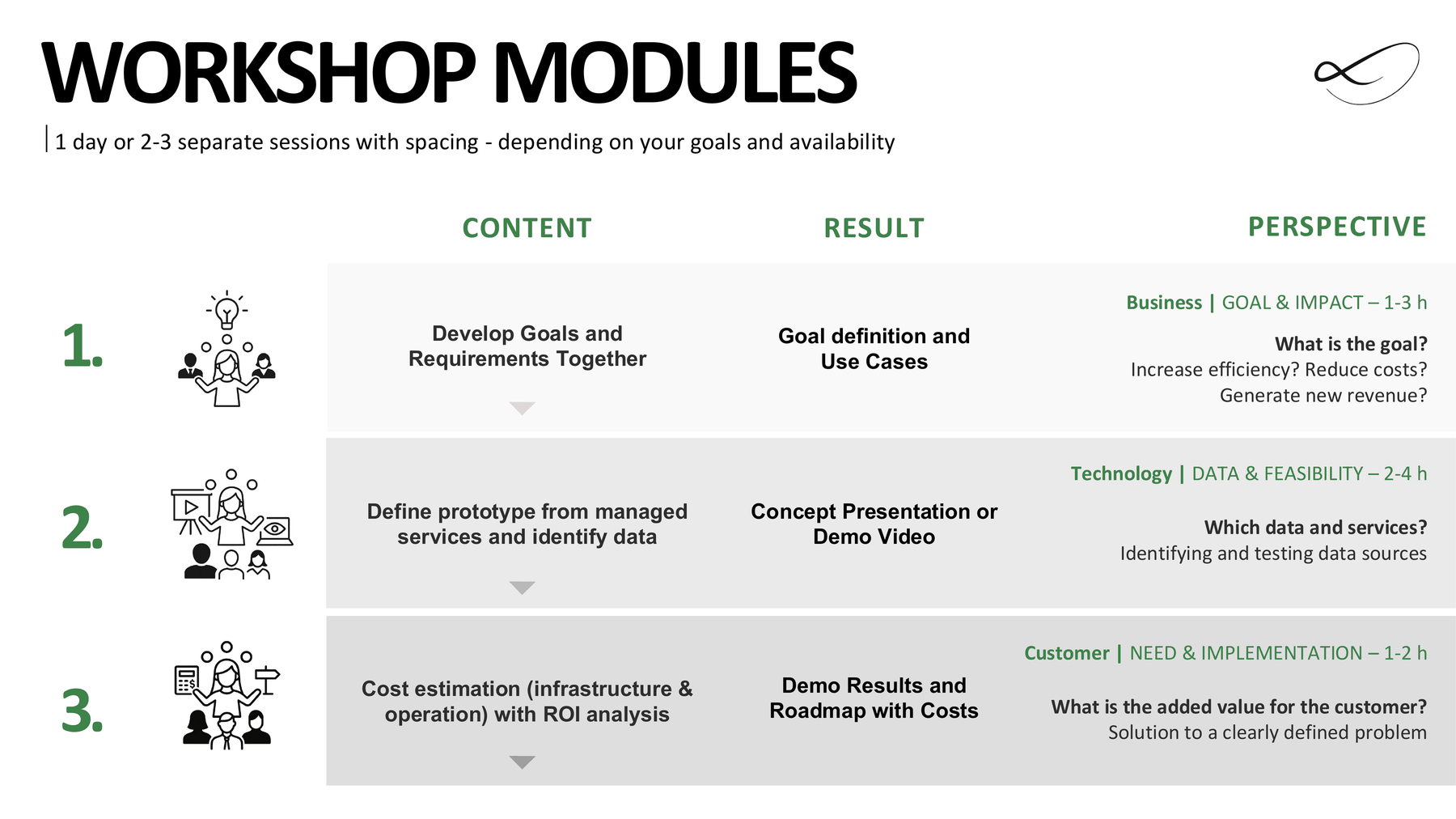
Each session ends with a decision. Sessions run one to four weeks apart, or as one long day if that suits your team better.
Goal
Business problems, candidate use cases, scoring. Result: the ranked shortlist.
Concept
Architecture per surviving use case, priced per AWS service and tested against real data.
Decision
ROI, MVP scope and the funding case. Go, stop or narrow. Stopping early is a good outcome.
Goal
The goal, the users and the scored shortlist.
Concept
Architecture and cost for the top candidate.
Decision
Go, stop or narrow, with the evidence behind it.
Funded proof of concept
Built on real data, often with cloud funding behind it.
Or all in one day. The gaps exist so your people can go and check things between sessions. Where that is not needed, the three sessions run back to back.
Pacing of the series. A cheap no after session two beats an expensive yes after six months.Source: Linda Mohamed, Partner Enablement 2026
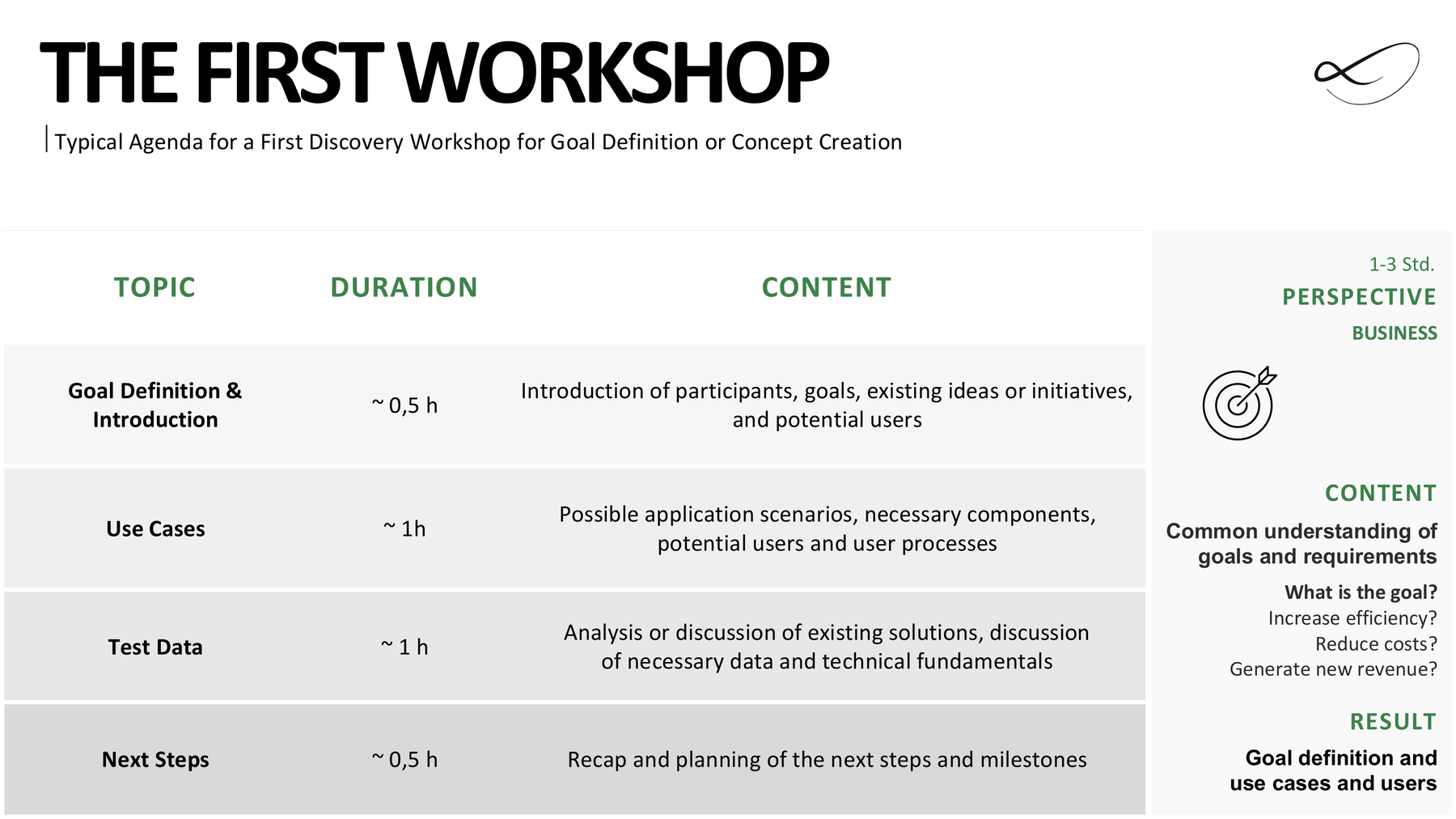
How a first workshop actually runs
The agenda I bring to a Discovery session. Timings shift with the group, the order rarely does.
Goal definition
What the organisation is trying to change, and what would count as proof. Everyone in the room writes it down separately first — the differences are the useful part.
Use cases
The candidates, and the named users behind each one. A use case without a named user does not leave the room.
Test data
What data exists, who owns it, and which awkward records have to be in any prototype.
Next steps
The shortlist, scored, and who does what before the next session.
Four blocks in one to three hours: goals, use cases, the data behind them, and the next steps. The right column is what leadership gets out of it.Source: Linda Mohamed, AI Use Cases Workshop deck, 2026
Discovery
Use cases, users and a scored shortlist. The disagreement in the room is the useful part.
Concept
Architecture sketches, effort, data access and the gaps nobody had written down.
Prototype
Built and evaluated on your data. After this the work moves to your engineers or a partner.
First functional version
An MVP with real users on it, built by your team or an implementation partner.
Market-ready solution
Scaled, operated and owned. The point the ladder was climbing towards.
Where Discovery sits in the series, and where the work moves to your engineers or an implementation partner.Source: Linda Mohamed, AI Use Cases Workshop deck, 2026
Real patterns, documented in the open.
Examples of the use cases that come up in Discovery sessions. Each opens a write-up on ai-solutions.wiki, the open engineering reference I maintain, with architecture, services and trade-offs.
Intelligent Document Processing with AI
A practical architecture for extracting structured data from invoices, contracts, and forms: combining OCR, classification, and LLM-based extraction.
Read on ai-solutions.wiki →InsuranceAI Claims Assistant - From Intake to Payout Recommendation
An AI assistant that guides claims from first notice of loss through evidence gathering, missing information detection, fraud screening, and payout recommendation: with human adjuster sign-off at every decision gate.
Read on ai-solutions.wiki →Customer supportAI Ticket Routing and Classification
Automated support ticket classification, priority assignment, and intelligent routing to the right agent or team based on content analysis and historical patterns.
Read on ai-solutions.wiki →ManufacturingAI Predictive Maintenance for Manufacturing
Sensor-driven predictive maintenance using machine learning to forecast equipment failures, optimize maintenance schedules, and reduce unplanned downtime.
Read on ai-solutions.wiki →Public sectorAI Permit Processing for Government Agencies
Automated permit application review, compliance checking, and workflow management to reduce processing times and improve consistency.
Read on ai-solutions.wiki →LegalAI Contract Analysis and Review
Automated contract review, clause extraction, risk identification, and obligation tracking using NLP and large language models.
Read on ai-solutions.wiki →The AWS services behind this work.
Discovery is not tied to one service. These are the ones that most often end up on the shortlist, with a plain note on what each does. The workshop checks which one fits before anyone builds.
Amazon Bedrock
Managed access to foundation models from several providers through one API. You choose the model and write the prompt; AWS runs the model.
Amazon Bedrock Knowledge Bases
Retrieval-augmented generation: your documents are chunked, embedded and stored in a vector store, and the relevant parts go into the prompt.
Amazon Textract
Reads text, forms and tables from scanned documents and returns them as structured data.
Amazon Transcribe
Speech to text with word timings, speaker labels and custom vocabularies.
Amazon SageMaker AI
Managed platform for the whole machine learning lifecycle: notebooks, training jobs, model registry and endpoints.
AWS Pricing Calculator
Builds a cost estimate per service before anything is deployed.
Check AWS funding before you pay.
Many AI proofs of concept and cloud migrations qualify for AWS funding: credits for the AWS usage and, in some partner programmes, funds for the delivery work. What applies depends on the project, the programme and the AWS account team. I check it in the Idea Call, and the workshop results are written so they can go straight into an application.
Proof of concept
For a prototype on AWS with a clear path to production.
Migration
For larger cloud moves, planned in phases.
What people ask before booking.
What does the AI Discovery Workshop cost?
€2,000 for the workshop plus €1,000 per written result. The standard package with the scored shortlist and the data and feasibility notes is €4,000 net. Additional results are optional.
Who should take part?
Up to 8 people: someone who owns the business problem, someone who knows the data, and someone from IT or engineering. Leadership joins for the last hour when the shortlist is agreed.
Do we need data or a clear idea before the workshop?
No. The intake form collects what you have. Sample data helps with the feasibility notes, but the session works without it.
Is the workshop tied to AWS?
The scoring is vendor-neutral. I build on AWS and hybrid platforms such as Red Hat OpenShift AI, and the feasibility notes name concrete services so the next step is buildable.
Can AWS funding pay for it?
Some projects qualify for AWS proof-of-concept funding. It depends on the project and the AWS account team, so I check it in the free Idea Call before you commit.
Remote or on-site?
Both. On-site in Vienna or anywhere in Europe (travel outside Vienna at cost), or fully remote. Sessions run in English or German.
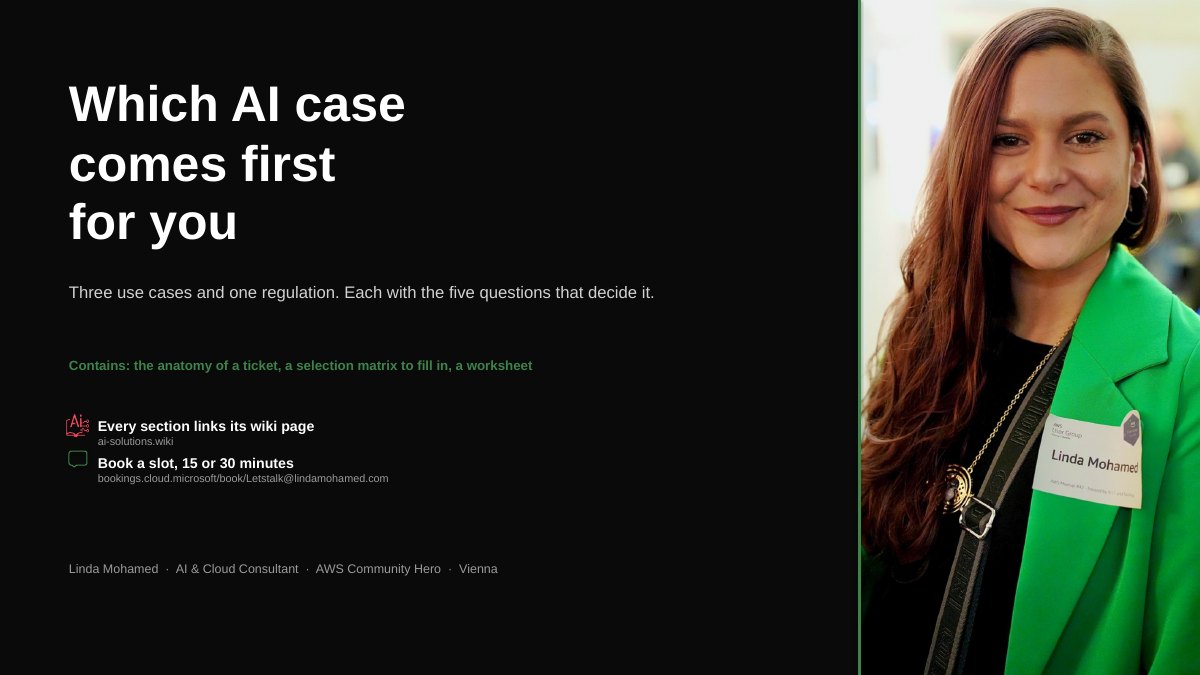
FREE DECK
AI Use Cases
Three use cases and one regulation. Each with the five questions that decide it.
- The anatomy of a ticket
- A selection matrix to fill in
- A worksheet
51 pages. Large type, one idea per page, sources on every page. Double opt-in: you confirm by email first. Unsubscribe with one click.

Linda Mohamed
I design and build AI and cloud systems on AWS and hybrid platforms, and I teach how they work. I have organised the AWS User Group Vienna for more than seven years, co-organise AWS Community Day DACH, teach AI architectures at Hochschule Burgenland, speak at conferences in Europe and the US, and maintain ai-solutions.wiki. Based in Vienna. Remote or on-site, in English or German.
Where the facts come from.
Prices, service names and limits change. The linked official pages are the reference; figures on this page were checked in September 2026.
- AWS Well-Architected Framework
- AWS Pricing Calculator
- AWS: AI services overview
- ai-solutions.wiki: From AI proof of concept to production
- ai-solutions.wiki: Build vs buy for AI
- ai-solutions.wiki: Total cost of ownership for AI
- ai-solutions.wiki: AWS funding for proofs of concept
- Regulation (EU) 2024/1689, the EU AI Act
Start with one conversation.
30 minutes to look at your idea, your data and the right starting point. Or book 15 minutes if you only have a question.
- Which of your ideas are worth a workshop
- Who should be in the room
- Whether AWS funding could apply
- Which results you actually need
Vienna, Austria · remote across Europe · [email protected]