
How I work: real data, real constraints, and a working prototype
Most organisations do not fail at AI because of technology. They fail because decisions are made too early: on assumptions nobody tested, with data that is not available the way people think, and without the people who have to agree in the room.
- Structured validation
- Real data, real constraints
- AWS and hybrid
- English or German
Alignment first, feasibility second, decision third
This is not one workshop day. It is a sequence that matches how organisations actually decide: agree on the goal, test whether it can be built, then commit or stop. Each step ends with something written down, so the next meeting starts where the last one ended.
What you get is a prioritised use-case list, feasibility checked against real data, deployment options that fit your constraints (cloud, hybrid or on-premises), and a roadmap somebody can sign[1]. Not a list of AI ideas.
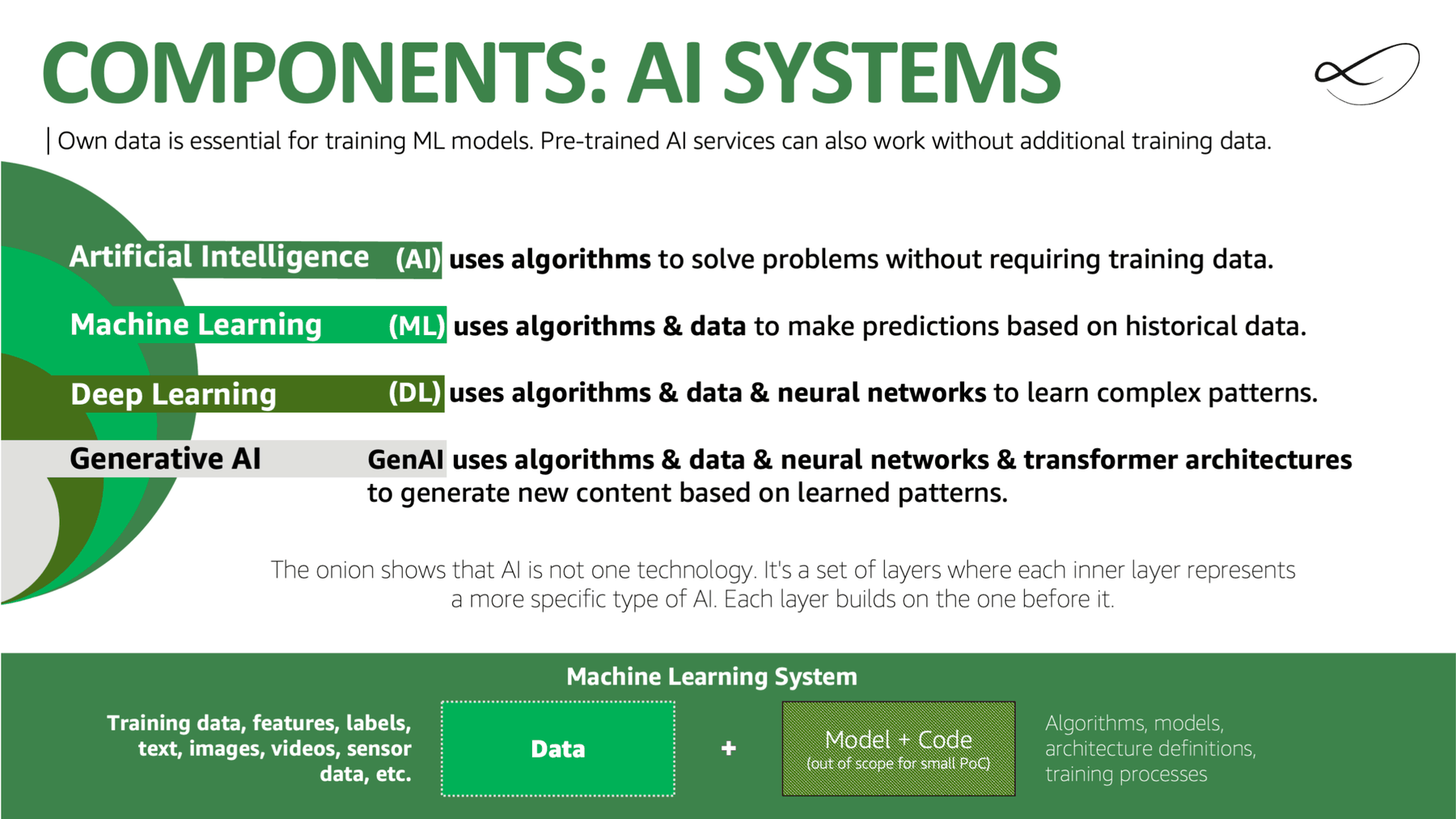
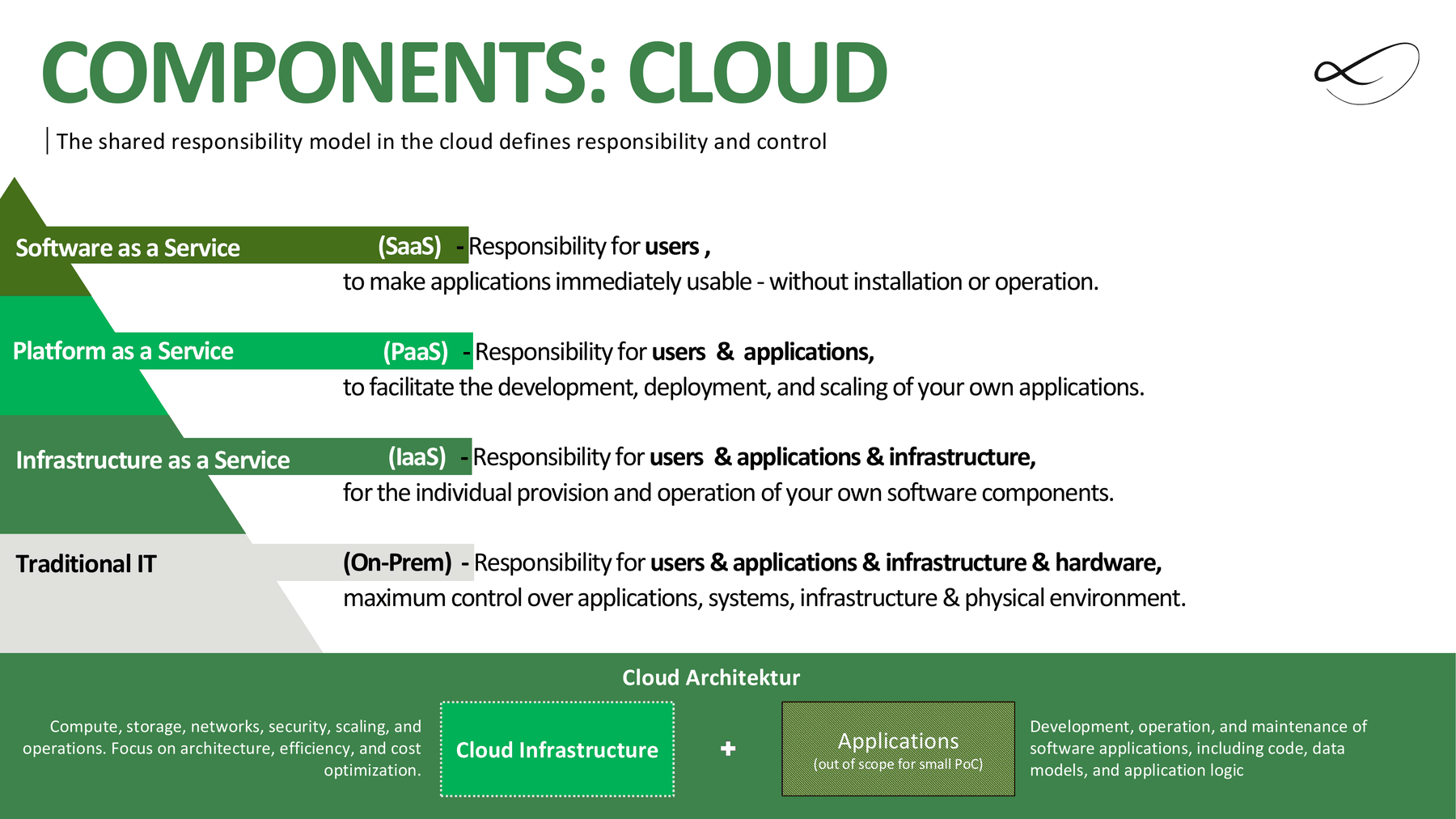
I build on AWS and on hybrid platforms such as Red Hat OpenShift AI, and I teach the same material as a lecture at Hochschule Burgenland. The layer map from that lecture is the tool I use to keep the platform question separate from the model question.
An idea
Is there something here?
A sentence anyone can say out loud. No architecture yet, and no budget.
Free 30-min callA scored use case
Which one first?
The shortlist, scored on value and on effort, with the reason written down. Out: a ranked list
A concept
What would it cost?
Architecture, the layer decision, and a cost model per service. Out: a price you can take to finance
A prototype
Does it work on our data?
Built on your real data, with the awkward records included. Out: measured results
A decision
Go, stop or narrow?
Written down with what would change the answer. Stopping here is a good outcome.
Decision pointProduction
Who runs it?
Built properly, operated, and owned by a named team. Out: a running service
Each rung ends with a decision, and stopping early is a valid one. Most of the money lost on AI projects is spent after the rung where someone should have stopped.
The ladder: idea, scored use case, concept with architecture and cost, prototype on real data, decision, production.Source: Linda Mohamed, AI Use Cases Workshop deck, 2026
Three expensive habits, avoided on purpose
Picking the platform first
The tool gets chosen before anyone wrote down where the data may live or who operates the thing. The layer map puts those questions first.
Pilots that cannot fail
A demo on curated data proves nothing. Every prototype here has success criteria agreed before it is built.
Cost as an afterthought
Cost per request decides whether a use case survives contact with production. It is priced in the concept session, not after launch.
The user
“Who is this for, and what does the day look like afterwards?”
- Users and personas, named, not assumed
- The journey as it should be, end to end
- What people do today and what breaks
- Which part of it AI is actually allowed to touch
In the room: Product owners, business analysts, designers, service and support
The business
“What is it worth, what is in the way, and who signs?”
- The value chain the use case sits in
- Constraints that are real: legal, contractual, political
- The business case, with the numbers written down
- What success is measured by, before anyone builds
In the room: Finance, business owners, legal, compliance, leadership
The technology
“Can it be built, run and defended?”
- Architecture, data access and the layer decision
- How it is built, reviewed, tested and deployed
- Security, certification evidence, audit trail
- What it costs to run and who is on call
In the room: Engineering, platform, data, security, operations
Governance sits at every layer, not at the end. Who may see what, what has to be logged, and what an auditor will ask for are questions for all three perspectives — which is why they are asked in this order rather than after the build.
The order I ask in: people, business, technology, with governance at every layer.Source: Linda Mohamed, lecture “Von Managed zu Hybrid: KI-Architekturen”, Hochschule Burgenland, 2026
Pick the step you actually need
One pricing rule everywhere: €2,000 per workshop and €1,000 per written result. Net, plus VAT.
Idea Call
Thirty minutes on your idea, the right next step and whether funding applies.
Discovery Workshop
Collect and score every candidate use case with the people who own them.
Concept Workshop
Architecture, cost per AWS service and an MVP scope with the trade-offs named.
Validation Workshop
A working prototype on your data, measured, with a go or stop decision.
AI agent systems
Multi-agent architecture on Amazon Bedrock AgentCore: build or review.
Architecture layers review
Bedrock, SageMaker AI or your own platform, cloud or hybrid, decided by constraint.
The full catalogue, including readiness, security assessments and the hands-on agent training, is on the workshops page.
What gets automated in practice
Documents, media and decisions, with a person kept where the risk is. The same five-step shape fits most of them: ingest, analyse, decide, render, publish.

Discovery workshop
The use cases, the users behind them, and a shortlist scored on value and effort.
Concept workshop
The top candidate becomes an architecture with a layer decision and a cost model.
Prototype workshop
Built on your own data, evaluated before anyone decides anything.
After the three steps: MVP development and scaling with your team or an implementation partner. Each workshop runs one to four hours, and you can book a single step on its own.
How the work is packaged: three workshops of one to four hours each, then MVP development and scaling with your team or a partner. You can also book a single step.Source: Linda Mohamed, AI Use Cases Workshop deck, 2026
Real patterns, documented in the open.
Worked examples on ai-solutions.wiki, the open engineering reference I maintain: architecture, AWS services and trade-offs for each.
Intelligent Document Processing with AI
A practical architecture for extracting structured data from invoices, contracts, and forms: combining OCR, classification, and LLM-based extraction.
Read on ai-solutions.wiki →Customer supportAI Self-Service Automation for Customer Support
Intelligent self-service systems using conversational AI, guided resolution flows, and automated actions to resolve customer issues without agent involvement.
Read on ai-solutions.wiki →MediaAI Transcription with Accurate Speaker Attribution
How to achieve production-quality multi-speaker transcription with speaker diarization, using AWS Transcribe and Bedrock post-processing.
Read on ai-solutions.wiki →LogisticsAI Route Optimization for Logistics
Dynamic route planning and optimization using machine learning to minimize delivery costs, reduce fuel consumption, and improve on-time performance.
Read on ai-solutions.wiki →LegalAI Contract Analysis and Review
Automated contract review, clause extraction, risk identification, and obligation tracking using NLP and large language models.
Read on ai-solutions.wiki →InsuranceAI Underwriting Automation for Insurance
Automated risk assessment, pricing, and policy issuance using machine learning models that process applications, medical records, and external data sources.
Read on ai-solutions.wiki →Check AWS funding before you pay.
Many AI proofs of concept and cloud migrations qualify for AWS funding: credits for the AWS usage and, in some partner programmes, funds for the delivery work. What applies depends on the project, the programme and the AWS account team. I check it in the Idea Call, and the workshop results are written so they can go straight into an application.
Proof of concept
For a prototype on AWS with a clear path to production.
Migration
For larger cloud moves, planned in phases.
What people ask before booking.
Do you also build, or only advise?
Both. The workshops end with a decision; prototypes are built with your team in your AWS account. Larger builds are scoped separately.
What does a typical engagement cost?
€2,000 per workshop plus €1,000 per written result. Most teams start with Discovery at €4,000 or go straight to Concept at €5,000.
Which industries?
Mostly enterprise: finance, insurance, public sector, media and manufacturing. The wiki has 130 documented use cases by industry.
Do you work on-site?
Yes, in Vienna and across Europe (travel outside Vienna at cost), or fully remote. Sessions run in English or German.
Can this run on our own infrastructure?
Yes. Hybrid and on-premises setups with Red Hat OpenShift AI are part of what I do; the layers review decides when that is worth it.

Linda Mohamed
I design and build AI and cloud systems on AWS and hybrid platforms, and I teach how they work. I have organised the AWS User Group Vienna for more than seven years, co-organise AWS Community Day DACH, teach AI architectures at Hochschule Burgenland, speak at conferences in Europe and the US, and maintain ai-solutions.wiki. Based in Vienna. Remote or on-site, in English or German.
Where the facts come from.
Prices, service names and limits change. The linked official pages are the reference; figures on this page were checked in September 2026.
Book it right here.
All prices are net. Companies outside Austria pay no VAT and can book directly by card. Companies in Austria, please choose “Pay by invoice”: 20% VAT is added there.
AI Discovery Workshop
One session and two written results, starting with the scored use-case shortlist.
Buy now →Pay by invoiceAI Concept Workshop
One session and three written results, including the architecture blueprint and the AWS service mapping.
Buy now →Pay by invoiceAI Single Session
Focused help on one roadblock: an architecture audit, a vendor evaluation or a technical deadlock.
Buy now →Pay by invoiceStart with one conversation.
30 minutes to look at your idea, your data and the right starting point. Or book 15 minutes if you only have a question.
- Where you are on the ladder
- Which step is worth the money
- What your data allows
- Whether AWS funding could apply
Vienna, Austria · remote across Europe · [email protected]