
Two hours to turn a list of ideas into one decision
A working session, not a presentation. Your team brings the problems and whatever data you can share. We collect every candidate use case, score them together on value, feasibility, data and funding, and agree on where to start.
- 2 to 3 hours
- €2,000 per workshop
- €1,000 per written result
- Remote or on-site
Three roles, up to eight people
Someone who owns the business problem, someone who knows where the data really lives, and someone from IT or engineering who knows what may be connected to what. Leadership joins for the last half hour, when the shortlist is agreed.
Everyone in the room votes on the scoring. That is the point: the ranking survives the next steering meeting because the people who would have argued about it were there when it was made.
The session runs in English or German, remote or at your office. Remote works well when the group is spread across locations; on-site works better when the data owners have to be pulled out of their day.
What happens, block by block
A typical three-hour session. Two hours works when the group is small and the candidates are already written down.
| Block | Time | What happens |
|---|---|---|
| Frame | 20 min | The business goal, the constraints that are not negotiable, and what would count as success |
| Collect | 40 min | Every candidate use case on the board, including the ones people expect me to reject |
| Score | 50 min | Value, feasibility, data readiness and funding eligibility, scored together and visibly |
| Check the data | 30 min | For the top candidates: what data exists, who owns it, and what blocks access |
| Decide | 30 min | One recommendation, the runners-up, and what not to do yet |
| Next steps | 10 min | Who does what before the concept workshop |
Written results follow within five business days, so nobody has to take minutes.
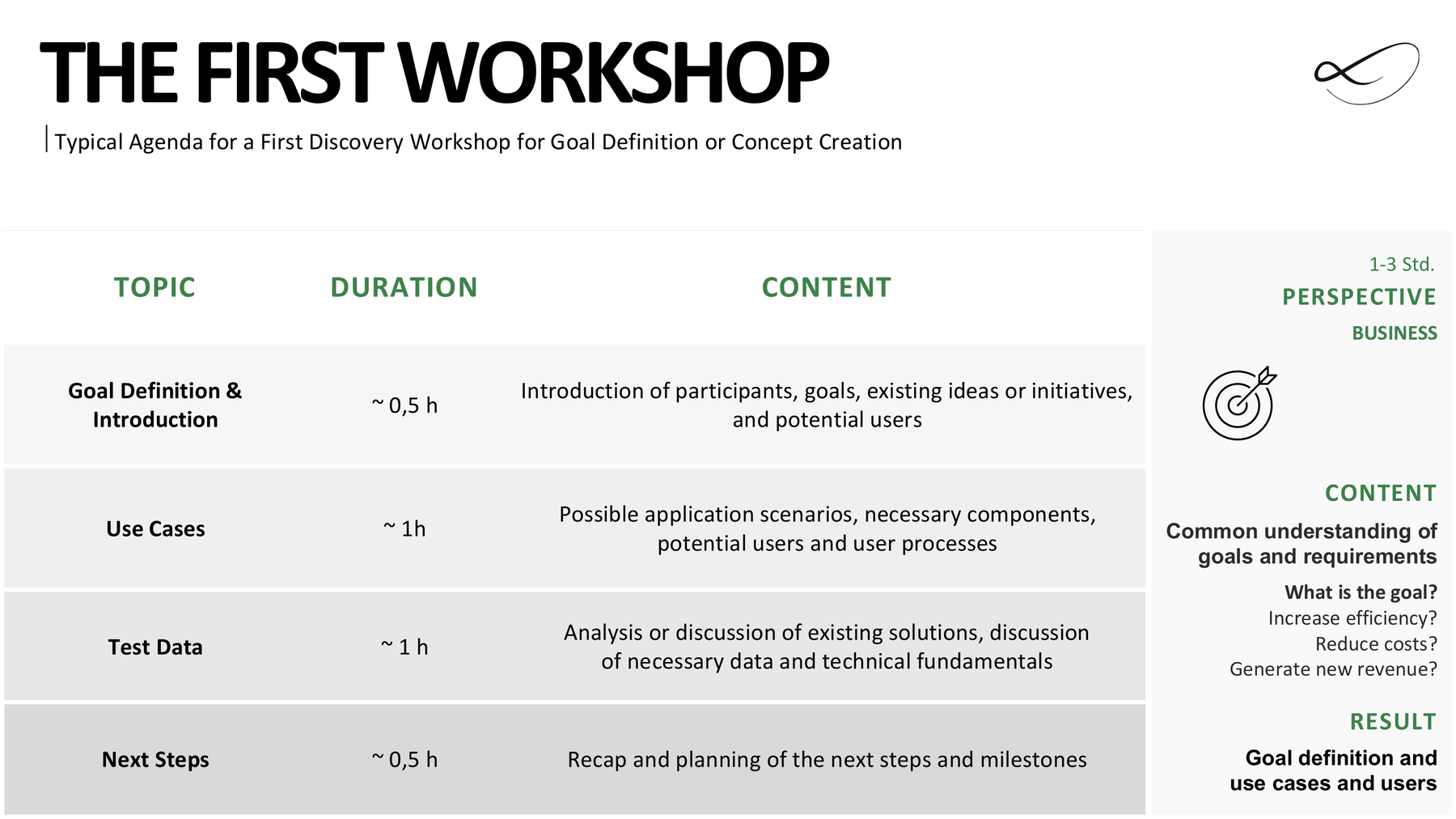
The slide I send beforehand
Goal definition
What the organisation is trying to change, and what would count as proof. Everyone in the room writes it down separately first — the differences are the useful part.
Use cases
The candidates, and the named users behind each one. A use case without a named user does not leave the room.
Test data
What data exists, who owns it, and which awkward records have to be in any prototype.
Next steps
The shortlist, scored, and who does what before the next session.
Four blocks, one to three hours. The right column is what the sponsor gets out of it: a goal everyone agrees on, and the use cases and users behind it.Source: Linda Mohamed, AI Use Cases Workshop deck, 2026
What you take away
The workshop is €2,000. Each written result is €1,000, so you only pay for the documents you need. The standard package includes the first two.
Scored use-case shortlistIncluded
Every candidate with its score on value, feasibility, data readiness and funding, so the ranking is reviewable later.
Data and feasibility notesIncluded
For the top three: which data exists, who owns it, what blocks access, and which AWS services would do the work.
Funding eligibility checkOptional
Which candidates fit AWS proof-of-concept or migration funding, and what an application needs[3].
First-project briefOptional
One page per recommended use case: goal, users, success measure, rough cost range and the next decision.
One workshop, the results you choose
Tick the results you want and the total updates. Net prices, plus VAT.
Discovery Workshop
Pre-session intake, the live session with up to 8 people, written results within 5 business days.
€2,000 each, 3 to 4 hours, remote or on-site
Delivered within 5 business days after the last session.
Discovery
Real patterns, documented in the open.
The kind of candidates that show up in Discovery sessions. Each opens a write-up on ai-solutions.wiki with architecture, AWS services and trade-offs.
Intelligent Document Processing with AI
A practical architecture for extracting structured data from invoices, contracts, and forms: combining OCR, classification, and LLM-based extraction.
Read on ai-solutions.wiki →Customer supportAI Ticket Routing and Classification
Automated support ticket classification, priority assignment, and intelligent routing to the right agent or team based on content analysis and historical patterns.
Read on ai-solutions.wiki →InsuranceAI Claims Assistant - From Intake to Payout Recommendation
An AI assistant that guides claims from first notice of loss through evidence gathering, missing information detection, fraud screening, and payout recommendation: with human adjuster sign-off at every decision gate.
Read on ai-solutions.wiki →ManufacturingAI Quality Control in Manufacturing
How computer vision AI enables automated visual inspection in manufacturing: detecting defects, reducing false positives, and integrating with production lines.
Read on ai-solutions.wiki →Public sectorAI Permit Processing for Government Agencies
Automated permit application review, compliance checking, and workflow management to reduce processing times and improve consistency.
Read on ai-solutions.wiki →HRAI for Recruitment and Talent Screening
How AI assists recruitment teams with resume screening, candidate matching, and interview scheduling: with guidance on bias mitigation and compliance.
Read on ai-solutions.wiki →What people ask before booking.
How long is the session?
Two to three hours. Longer sessions lose the people you need most, so the scoring is built to fit that window.
Do we need data before the workshop?
No. The intake form collects what you have. Sample data makes the feasibility notes sharper, but the session works without it.
What if we already know our use case?
Then skip Discovery and start with the Concept workshop, where the architecture and the cost per AWS service get written down.
Is this tied to AWS?
The scoring is vendor-neutral. I build on AWS and on hybrid platforms such as Red Hat OpenShift AI, and the notes name concrete services so the next step is buildable.
What does it cost?
€2,000 for the workshop plus €1,000 per written result. The standard package is €4,000 net.

Linda Mohamed
I design and build AI and cloud systems on AWS and hybrid platforms, and I teach how they work. I have organised the AWS User Group Vienna for more than seven years, co-organise AWS Community Day DACH, teach AI architectures at Hochschule Burgenland, speak at conferences in Europe and the US, and maintain ai-solutions.wiki. Based in Vienna. Remote or on-site, in English or German.
Where the facts come from.
Prices, service names and limits change. The linked official pages are the reference; figures on this page were checked in September 2026.
Start with one conversation.
30 minutes to look at your idea, your data and the right starting point. Or book 15 minutes if you only have a question.
- Which of your ideas are worth a session
- Who should be in the room
- Which written results you need
- A date
Vienna, Austria · remote across Europe · [email protected]