
Turning one chosen use case into something your engineers can build
We sketch the end-to-end flow, name the AWS services, price them per service, and cut the scope down to a first version that can actually ship. What stays out is written down as clearly as what goes in.
- 2 to 3 hours
- €5,000 with 3 results
- Architecture and cost model
- Remote or on-site
Most prototypes die on plumbing long before the model
The model is rarely the hard part. The hard parts are where the data comes from, who is allowed to see it, what happens when a call fails, and what the thing costs per request once real traffic arrives.
In the Concept workshop we draw that end to end: sources, processing, the model call, storage, the interface people use, and the failure paths. Then every box gets a service name and a price, using the AWS Pricing Calculator[2] so nobody has to trust a gut feeling.
The last block is scope. We split the wish list into a first version, a second version and a pile called not now. The MVP is whatever answers the open question at the lowest cost.
What happens, block by block
| Block | Time | What happens |
|---|---|---|
| Frame | 15 min | The use case, the success measure and the constraints from Discovery |
| Flow | 45 min | End-to-end sketch: sources, processing, model call, storage, interface, failure paths |
| Services | 30 min | Each box gets an AWS service, with the alternatives named and the reason for the choice |
| Cost | 30 min | Price per service and per request, with the assumptions written next to the number |
| Scope | 40 min | First version, second version, not now. Value against effort, decided in the room |
| Risks | 20 min | What could make this fail, and which test would find out cheaply |
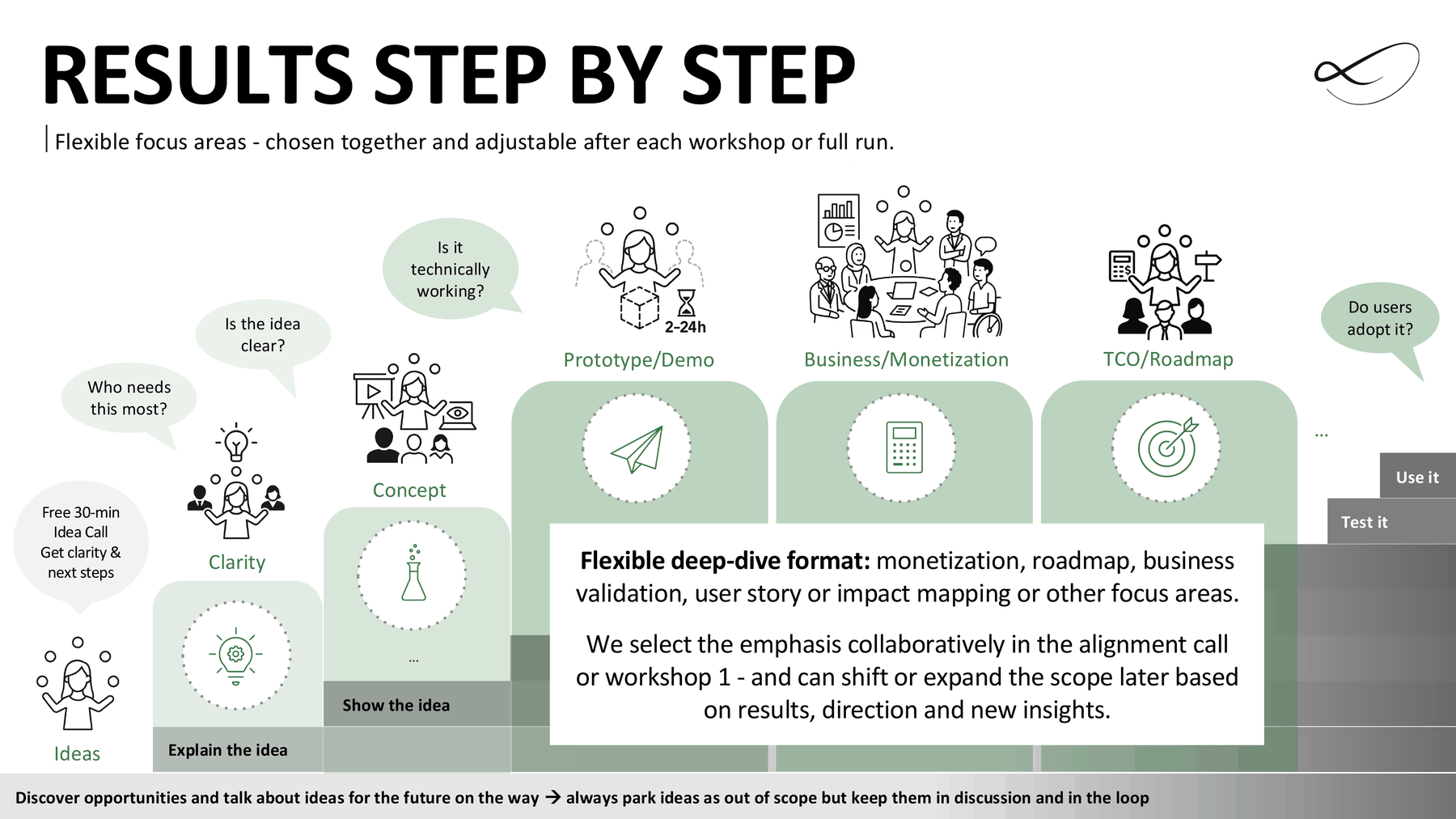
Goal
What the organisation is actually trying to change, and the measure that would prove it.
Concept
The top candidate from the shortlist becomes an architecture with a price attached.
Decision
Go, stop or narrow — with the evidence to back whichever one it is.
Concept is session two. It takes the shortlist from Discovery and turns the top candidate into an architecture with a price.Source: Linda Mohamed, Partner Enablement 2026
What you take away
The workshop is €2,000, each written result €1,000. The Concept package includes three.
Architecture per use caseIncluded
The end-to-end diagram with every service named, plus the alternatives that were rejected and why[1].
Cost model per serviceIncluded
Monthly and per-request cost with the assumptions listed, so finance can challenge the inputs instead of the result[3].
MVP scopeIncluded
What the first version includes, what it deliberately leaves out, and the success criteria it has to meet.
Build vs buy noteOptional
Where a ready-made product would be cheaper than building, with the switching cost named[4].
The session before this one, and the one after
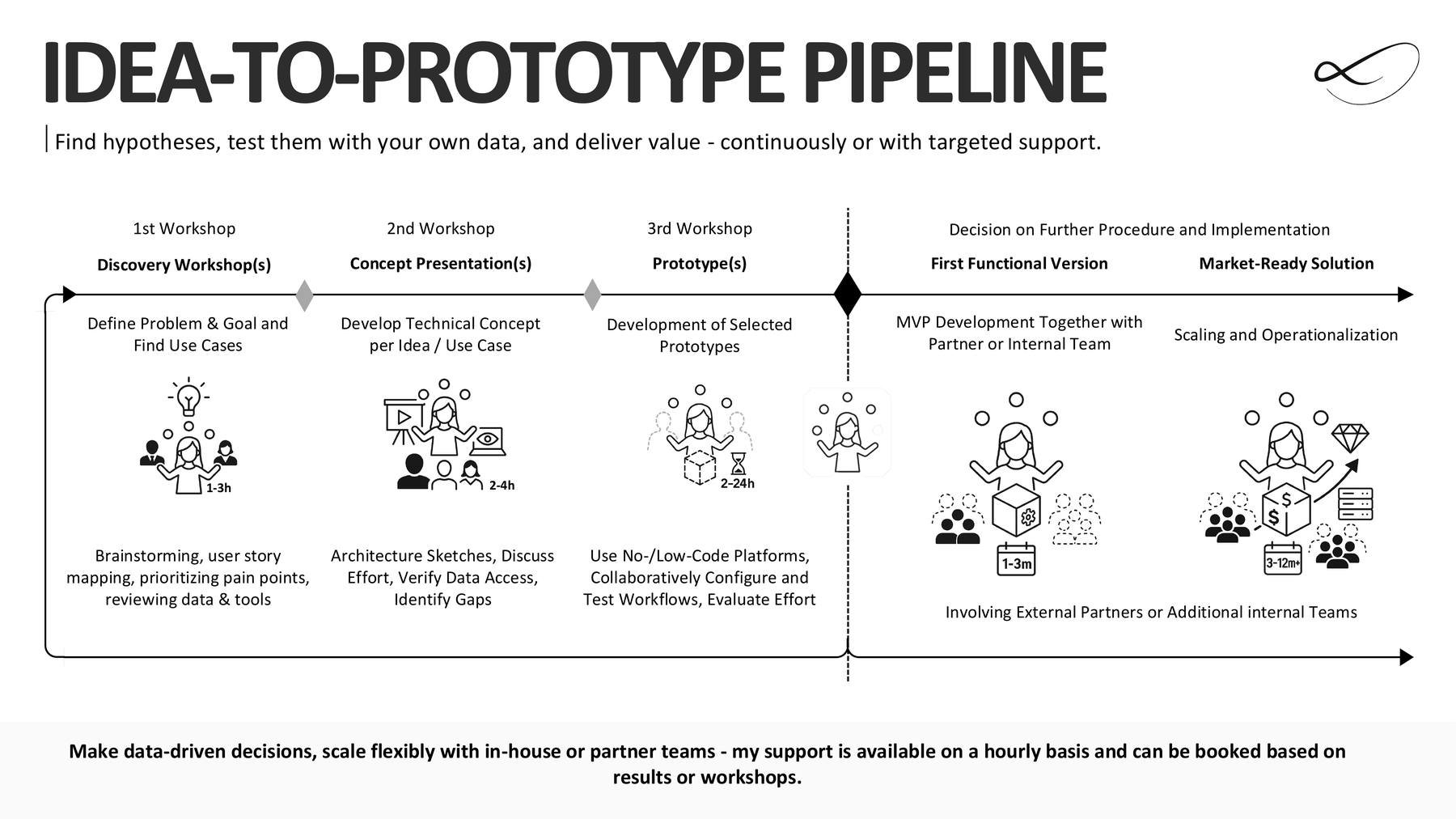
Concept is the middle session. It only works if Discovery has already cut the list, and it exists so the prototype has something to build.
Discovery
Use cases, users and a scored shortlist. The disagreement in the room is the useful part.
Concept
Architecture sketches, effort, data access and the gaps nobody had written down.
Prototype
Built and evaluated on your data. After this the work moves to your engineers or a partner.
First functional version
An MVP with real users on it, built by your team or an implementation partner.
Market-ready solution
Scaled, operated and owned. The point the ladder was climbing towards.
Where Concept sits: architecture sketches, effort, data access and gaps. After the third session the work moves to your engineers or an implementation partner.Source: Linda Mohamed, AI Use Cases Workshop deck, 2026
Concept workshop, €5,000
One workshop plus three written results. Net prices, plus VAT.
AI Concept Workshop
Intake, the live session with up to 8 people, written results within 5 business days.
€2,000 each, 3 to 4 hours, remote or on-site
Delivered within 5 business days after the last session.
Concept
The AWS services behind this work.
The services that most often end up in a concept, with a plain note on what each one does and a link to the AWS documentation.
Amazon Bedrock
Managed access to foundation models from several providers through one API. You choose the model and write the prompt; AWS runs the model.
Amazon Bedrock Knowledge Bases
Retrieval-augmented generation: your documents are chunked, embedded and stored in a vector store, and the relevant parts go into the prompt.
Amazon Textract
Reads text, forms and tables from scanned documents and returns them as structured data.
AWS Step Functions
Workflow engine that runs steps in order or in parallel, with retries and waits, and shows every run.
AWS Lambda
Runs small pieces of code on demand without servers to manage. You pay per request and duration.
AWS Pricing Calculator
Builds a cost estimate per service before anything is deployed.
What people ask before booking.
Do we need Discovery first?
No, but you need one use case that the room agrees on. If you have five candidates, Discovery is cheaper than arguing in the Concept session.
Who should join?
The people who will build or operate it, plus whoever owns the data. Up to eight people.
What if the cost model kills the idea?
Then it did its job for €5,000 instead of after six months of building. That outcome happens, and the notes say why.
Do you write code in this session?
No. The Concept workshop ends with an architecture, a price and a scope. Code starts in the Prototype workshops.
What does it cost?
€5,000 net: one workshop plus three written results.

Linda Mohamed
I design and build AI and cloud systems on AWS and hybrid platforms, and I teach how they work. I have organised the AWS User Group Vienna for more than seven years, co-organise AWS Community Day DACH, teach AI architectures at Hochschule Burgenland, speak at conferences in Europe and the US, and maintain ai-solutions.wiki. Based in Vienna. Remote or on-site, in English or German.
Where the facts come from.
Prices, service names and limits change. The linked official pages are the reference; figures on this page were checked in September 2026.
Start with one conversation.
30 minutes to look at your idea, your data and the right starting point. Or book 15 minutes if you only have a question.
- The use case you want designed
- What your data allows
- Which results you need
- A date
Vienna, Austria · remote across Europe · [email protected]