

Cursor: the editor and the agent in one product
Cursor is a code editor with its own coding agent. The same agent also runs in the cloud, in the terminal and on iOS.
Cursor sorts itself around one editor, and you adopt that editor. The Agent works inside it. The same agent runs as Cloud Agents on machines in the cloud, in the CLI and in the iOS app. Anysphere builds Cursor. SpaceX completed its acquisition of the company in August 2026.
You pick the model per request, or you leave it on Auto. Cursor offers its own models, Composer and Grok, and models from Anthropic, OpenAI, Google and Meta. Whose account serves it: Cursor by default, or your own key for five providers. That route has two limits. Tab completion stays on Cursor's models, and Cursor's zero data retention no longer applies.
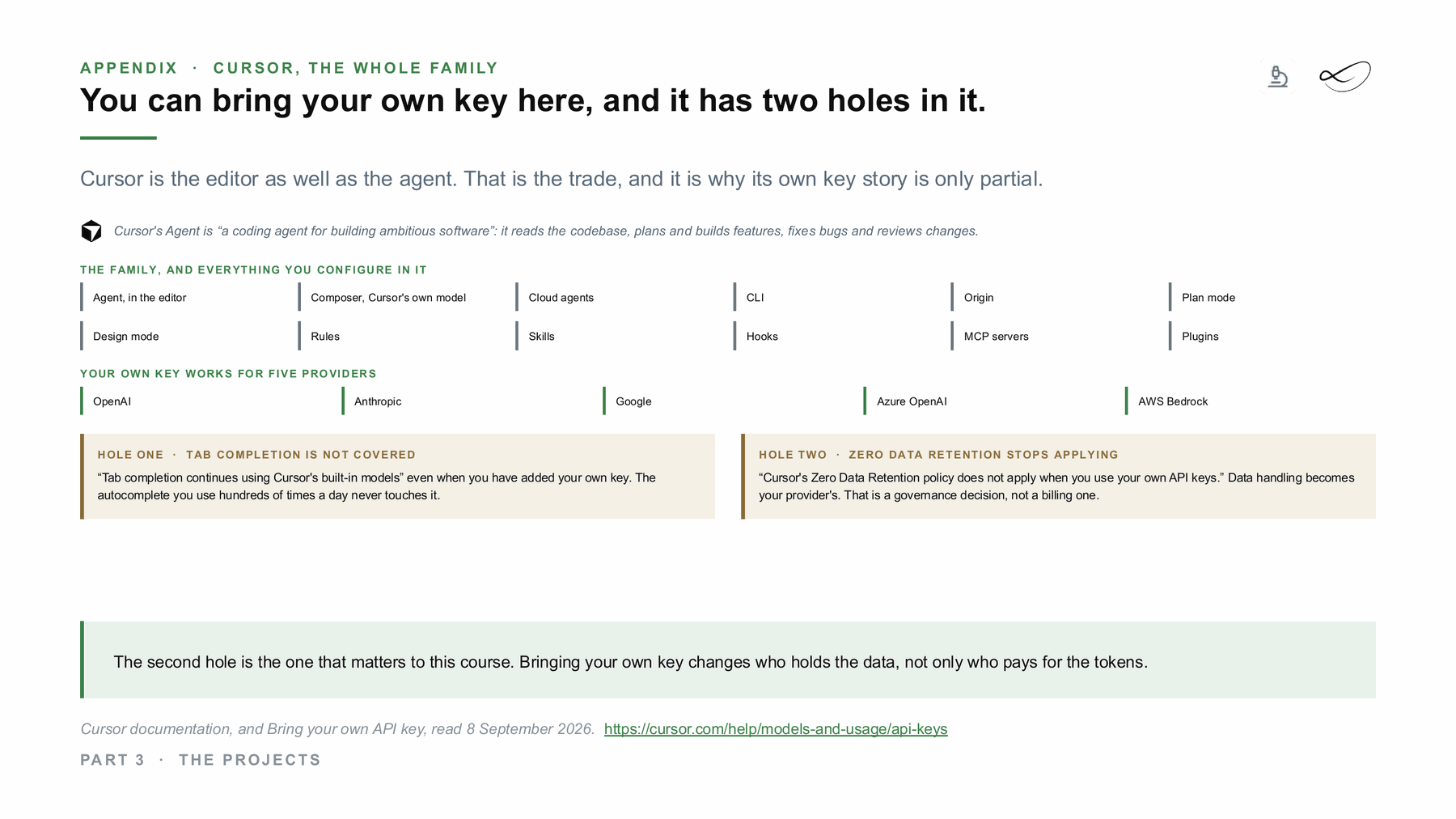
The family
Agent[2]
desktop editorCloud Agents[3]
cloud, started from editor, web, Slack or mobileSelf-Hosted Machines[4]
your own machinesCursor for iOS[6]
iOSDesign Mode[7]
desktop editorOrigin[9]
web, CLIPlans
Plan names as of September 2026. Business plans add team-wide Privacy Mode, SSO and admin controls.
| Plan | For | What changes |
|---|---|---|
| Hobby[10] | Trying Cursor out, free. | Limited usage. No Cloud Agents and no Bugbot. |
| Start[8] | Developers in India only. | Cursor's own models only (Composer and Grok). No third-party models, no Auto, no Bugbot. |
| Pro, Pro+, Ultra[8] | Individuals, by amount of use. | Two usage pools: Cursor's models and other models. Cloud Agents and Bugbot included. Requests with your own key do not use the included amount. |
| Teams[8] | Teams that manage Cursor themselves. Standard and Premium seats. | Central billing and admin, Privacy Mode on by default for all members, SAML/OIDC SSO, team rules, skills and plugins, usage analytics. |
| Enterprise[10] | Larger organisations. | Pooled usage, SCIM, audit logs, Privacy Mode on by default. US data residency, customer managed keys and Self-Hosted Team Pools on request. |
Which model runs
The user picks the model per request, or leaves it on Auto. On Teams and Enterprise, Cursor Router picks for Auto and admins can limit models. Tab completion always uses Cursor's own models. As of September 2026:
What you can configure
What happens to your data
Europe: GDPR, data residency and the AI Act
Hybrid: the same models in your own account
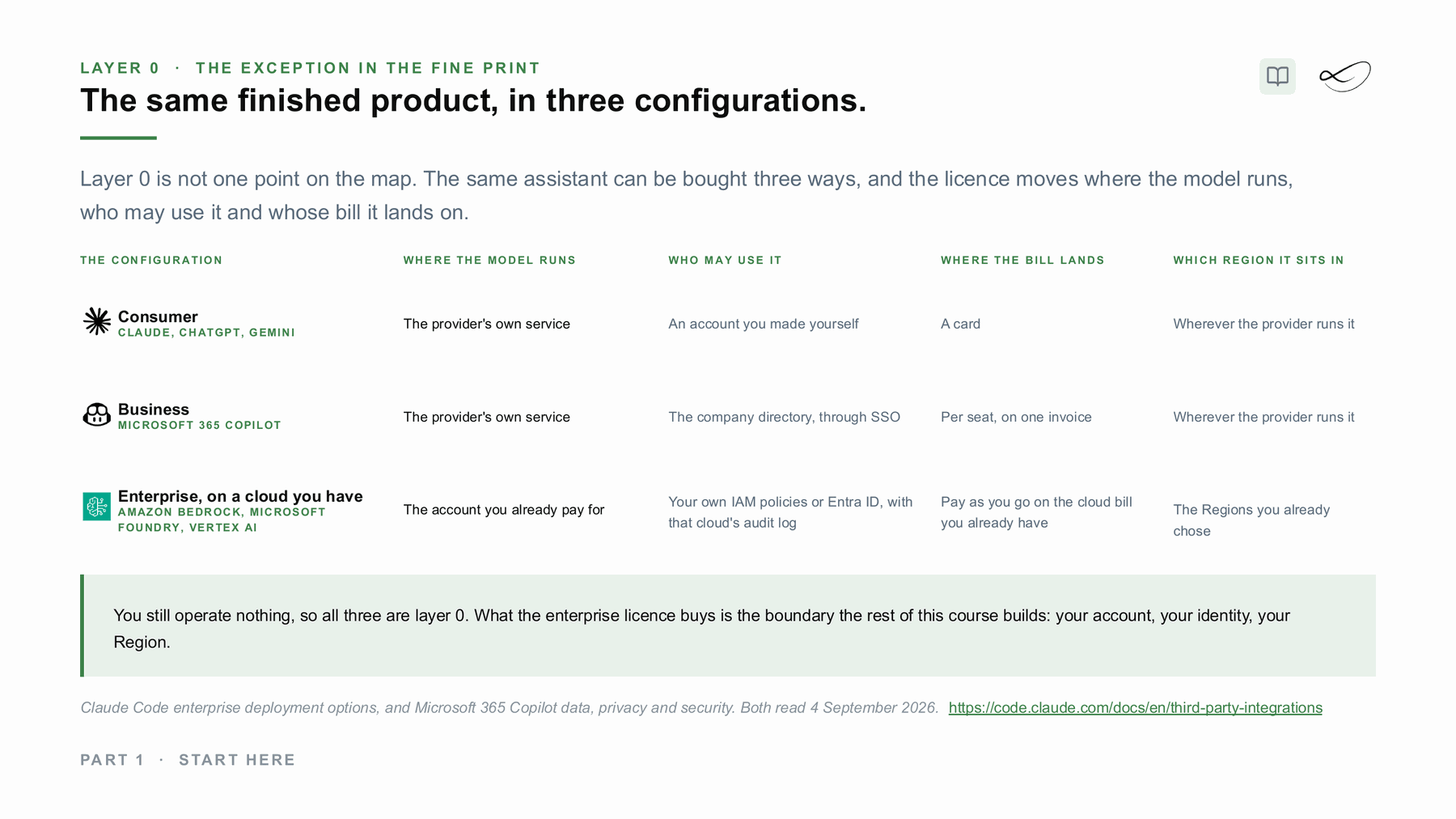
The third-party models can run through your own OpenAI, Anthropic, Google, Azure or Bedrock account. Requests still pass through Cursor, and some protections change on the way.
- SpaceX completed its acquisition of Cursor (14 Aug 2026).
- Grok models, built with SpaceXAI, joined Composer as first-party Cursor models (8 Jul 2026).
- Cursor acquired Continue, the open-source coding assistant. Its repository is now read-only (19 Jun 2026).
What would help you next?
Learn to decide
The course “From Managed to Hybrid” shows where AI should run: what each layer costs, what you operate and where your data has to stay. In preparation, with a free live session first.
 Linda Mohamed
AI and cloud consultant, AWS Community Hero, Vienna
Roll it out with me
Tell me which tools your teams use or want. In 30 minutes we look at plans, settings, data rules and whether AWS funding can cover part of a pilot. How AWS funding works →
You already know what you need
Book a workshop directly:
- Strands Agents Workshop →
One day for developers: build a working agent system with custom tools, MCP and agent-to-agent communication. - AI Enablement Workshop →
One workshop for one role, up to 12 people: how your team uses these tools well, and what stays inside the rules.

Read more on ai-solutions.wiki
My open knowledge base, with longer comparisons and sources.
Sources
- Linda Mohamed, course slides “The projects”, appendix layer 0, MASE-3, FH Burgenland, September 2026
- Agent, cursor.com. https://cursor.com/docs/agent/overview
- Cloud Agents, cursor.com. https://cursor.com/docs/cloud-agent
- Self-Hosted Machines, cursor.com. https://cursor.com/docs/cloud-agent/self-hosted
- Cursor CLI, cursor.com. https://cursor.com/docs/cli/overview
- Cursor for iOS, cursor.com. https://cursor.com/docs/cloud-agent/mobile
- Design Mode, cursor.com. https://cursor.com/docs/agent/design-mode
- Bugbot, cursor.com. https://cursor.com/docs/models-and-pricing
- Origin, cursor.com. https://cursor.com/docs/origin
- Hobby, cursor.com. https://cursor.com/pricing
- Grok 4.7, 4.6, 4.5, cursor.com. https://cursor.com/help/models-and-usage/grok-4-7
- Claude Fable 5.1, cursor.com. https://cursor.com/docs/enterprise/privacy-and-data-governance
- Muse Spark 1.3, cursor.com. https://cursor.com/docs/models/muse-spark-1-3
- Rules, cursor.com. https://cursor.com/docs/rules
- Skills, cursor.com. https://cursor.com/docs/skills
- Hooks, cursor.com. https://cursor.com/docs/hooks
- MCP servers, cursor.com. https://cursor.com/docs/mcp
- Plugins, cursor.com. https://cursor.com/docs/plugins
- SSO and SCIM, cursor.com. https://cursor.com/docs/account/teams/sso
- Your own API key, cursor.com. https://cursor.com/help/models-and-usage/api-keys
- Privacy Mode on, cursor.com. https://cursor.com/data-use
- Teams and Enterprise, cursor.com. https://cursor.com/help/security-and-privacy/privacy
- DPA / GDPR terms, cursor.com. https://cursor.com/terms/dpa
- Certifications, cursor.com. https://cursor.com/security
- AI Act, digital-strategy.ec.europa.eu. https://digital-strategy.ec.europa.eu/en/policies/contents-code-gpai
- Linda Mohamed, course slides “Start here”, MASE-3, FH Burgenland, September 2026
- Cursor, ai-solutions.wiki. https://ai-solutions.wiki/tools/cursor-ai/
- Claude Code vs Cursor vs Codex, ai-solutions.wiki. https://ai-solutions.wiki/comparisons/claude-code-vs-cursor-vs-codex/
- Cursor is now a part of SpaceX (14 Aug 2026). https://cursor.com/blog/joining-spacex
- Introducing Grok 4.5 (8 Jul 2026). https://cursor.com/blog/grok-4-5
- Continue (acquired by Cursor). https://continue.dev/
- Continue release v2.0.0-vscode (19 Jun 2026). https://github.com/continuedev/continue/releases/tag/v2.0.0-vscode
- Cursor enterprise docs (SOC 2, GDPR). https://cursor.com/docs/enterprise
Checked against the vendors' own pages in September 2026. Plans, models and features change often: check the linked pages before you decide.