

Kiro: a written spec as the unit of work
Kiro is the coding agent from AWS. It turns a prompt into a written spec first, and then writes the code.
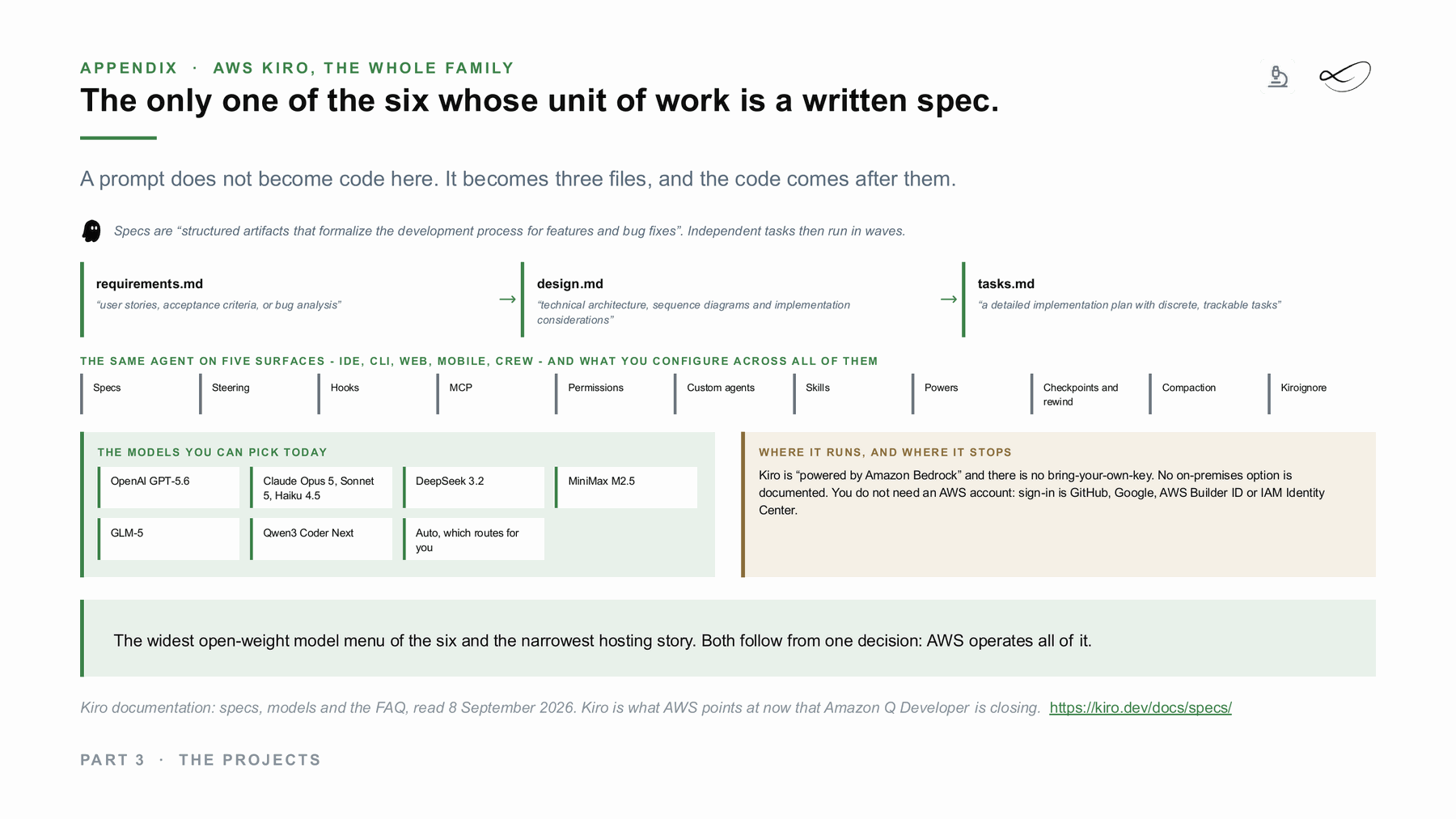
Kiro sorts itself by surface. The same agent runs in the IDE, in the CLI, in the browser, in an iOS app and in Crew, a workspace that runs on your own machine. What sets Kiro apart is the unit of work. A prompt becomes a spec: three files called requirements.md, design.md and tasks.md. The code comes after them.
You pick the model in chat, or you leave it on Auto. The menu has OpenAI, Anthropic and several open-weight models. Whose account serves it has one answer: AWS runs every model through Amazon Bedrock. No option for your own key or a local model is documented. You do not need an AWS account to start. People sign in with GitHub, Google or AWS Builder ID, and companies use IAM Identity Center.
The family
Kiro IDE[2]
desktop IDEKiro CLI[3]
CLIKiro Web[4]
webKiro for iOS[5]
iOSKiro Crew[6]
desktop, web dashboard, CLI, chatKiro in JetBrains IDEs[7]
JetBrains IDEPlans
Plan names as of September 2026. How you sign in matters as much as the plan: it decides whether your content may be used for service improvement.
| Plan | For | What changes |
|---|---|---|
| Kiro Free[8] | New users. No credit card needed. | 50 credits a month. Claude Sonnet 4.5 and open-weight models only, with rate limits. Not available for Enterprise or GovCloud. |
| Kiro Pro[8] | Individual developers. | 1,000 credits a month, premium models including Auto, Claude Sonnet 5 and Claude Opus 5, add-on credits, and Kiro Web. |
| Kiro Pro+[8] | Active individual developers. | 2,000 credits a month. Otherwise the same as Pro. |
| Kiro Pro Max[8] | Power users. | 5,000 credits a month. Otherwise the same as Pro. |
| Kiro Power[8] | Intensive users. | 10,000 credits a month. Otherwise the same as Pro. |
| Kiro for enterprise[8] | Organisations that sign in through IAM Identity Center or their own identity provider. | Central billing through AWS, SSO, usage analytics and admin controls. Content is not used for service improvement. |
Which model runs
The user picks a model for chat, or leaves it on Auto. Enterprise admins can limit the list and set a default. Model choice applies to chat only. As of September 2026:
What you can configure
What happens to your data
Europe: GDPR, data residency and the AI Act
Hybrid: the same models in your own account
Kiro has no route to run its models in your own cloud account: AWS runs the inference. What you can bring from your AWS account is your identity, your logs, your keys, your network and the Region.
- Amazon Q Developer IDE plugins and paid subscriptions reach end of support. AWS points IDE users to Kiro. Amazon Q in the AWS console is not affected (30 Apr 2027).
- New signups for Amazon Q Developer closed, including the free tier with Builder ID (15 May 2026).
What would help you next?
Learn to decide
The course “From Managed to Hybrid” shows where AI should run: what each layer costs, what you operate and where your data has to stay. In preparation, with a free live session first.
 Linda Mohamed
AI and cloud consultant, AWS Community Hero, Vienna
Roll it out with me
Tell me which tools your teams use or want. In 30 minutes we look at plans, settings, data rules and whether AWS funding can cover part of a pilot. How AWS funding works →
You already know what you need
Book a workshop directly:
- Strands Agents Workshop →
One day for developers: build a working agent system with custom tools, MCP and agent-to-agent communication. - AI Enablement Workshop →
One workshop for one role, up to 12 people: how your team uses these tools well, and what stays inside the rules.

Read more on ai-solutions.wiki
My open knowledge base, with longer comparisons and sources.
Sources
- Linda Mohamed, course slides “The projects”, appendix layer 0, MASE-3, FH Burgenland, September 2026
- Kiro IDE, kiro.dev. https://kiro.dev/docs/ide/
- Kiro CLI, kiro.dev. https://kiro.dev/docs/cli/
- Kiro Web, kiro.dev. https://kiro.dev/docs/web/
- Kiro for iOS, kiro.dev. https://kiro.dev/docs/mobile/
- Kiro Crew, kiro.dev. https://kiro.dev/docs/crew/
- Kiro in JetBrains IDEs, kiro.dev. https://kiro.dev/docs/upgrade-guides/migrating-from-q-developer/
- Kiro Free, kiro.dev. https://kiro.dev/pricing/
- Auto, kiro.dev. https://kiro.dev/docs/models/
- Specs, kiro.dev. https://kiro.dev/docs/specs/
- Steering, kiro.dev. https://kiro.dev/docs/steering/
- Hooks, kiro.dev. https://kiro.dev/docs/hooks/
- MCP, kiro.dev. https://kiro.dev/docs/mcp/
- Powers, kiro.dev. https://kiro.dev/docs/powers/
- Skills, kiro.dev. https://kiro.dev/docs/skills/
- Custom agents, kiro.dev. https://kiro.dev/docs/custom-agents/
- Permissions, checkpoints, .kiroignore, kiro.dev. https://kiro.dev/docs/
- Sign-in, kiro.dev. https://kiro.dev/docs/getting-started/authentication/
- Enterprise governance, kiro.dev. https://kiro.dev/docs/enterprise/governance/
- Free and individual subscribers (GitHub, Google or AWS Builder ID), kiro.dev. https://kiro.dev/docs/privacy-and-security/data-protection/
- Amazon Q Developer Pro subscribers, kiro.dev. https://kiro.dev/faq/
- DPA / GDPR terms, aws.amazon.com. https://aws.amazon.com/compliance/gdpr-center/
- AI Act, digital-strategy.ec.europa.eu. https://digital-strategy.ec.europa.eu/en/policies/contents-code-gpai
- Your identity, logs, keys and network, kiro.dev. https://kiro.dev/docs/privacy-and-security/vpc-endpoints/
- AWS GovCloud (US), kiro.dev. https://kiro.dev/docs/privacy-and-security/compliance-validation/
- Linda Mohamed, course slides “Start here”, MASE-3, FH Burgenland, September 2026
- Kiro, ai-solutions.wiki. https://ai-solutions.wiki/glossary/kiro/
- Claude Code vs Cursor vs Codex, ai-solutions.wiki. https://ai-solutions.wiki/comparisons/claude-code-vs-cursor-vs-codex/
- AWS: Amazon Q Developer end-of-support announcement. https://aws.amazon.com/blogs/devops/amazon-q-developer-end-of-support-announcement/
- AWS docs: Amazon Q Developer IDE plugins end of support. https://docs.aws.amazon.com/amazonq/latest/qdeveloper-ug/q-developer-ide-end-of-support.html
- Kiro license (AWS Content). https://kiro.dev/license/
Checked against the vendors' own pages in September 2026. Plans, models and features change often: check the linked pages before you decide.