
Text analysis: structure out of text you already have
Natural language processing (NLP) reads text and returns structure: the entities in it, key phrases, sentiment, the language, and personal data that should not travel further.


What is text analysis?
Text analysis is usually the second step in a chain. Something else produced the text, a transcript or an OCR result, and this step decides what is in it: names, places, organisations, the tone, the topic.
Finding personal data (PII) is often the most useful part. It decides what may be stored, shown or sent on, and it can be the step that draws the line between cloud and building.
Four ways to run it
Each of the big clouds offers it as a managed service, and you can also run it yourself. Same task, a different bill and a different console.
Amazon Comprehend[1]
The managed natural language processing service on AWS, including detection of personal data. You can train custom classifiers on your own labels.
Official documentation →Azure AI Language[2]
The managed language service on Microsoft Azure for entities, sentiment, personal data and summarisation.
Official documentation →Natural Language AI[3]
The managed text analysis API on Google Cloud.
Official documentation →spaCy, or a model from Hugging Face[4]
SpaCy is an open-source NLP library (MIT). For more specialised tasks, open models from Hugging Face run on your own machine.
Project page →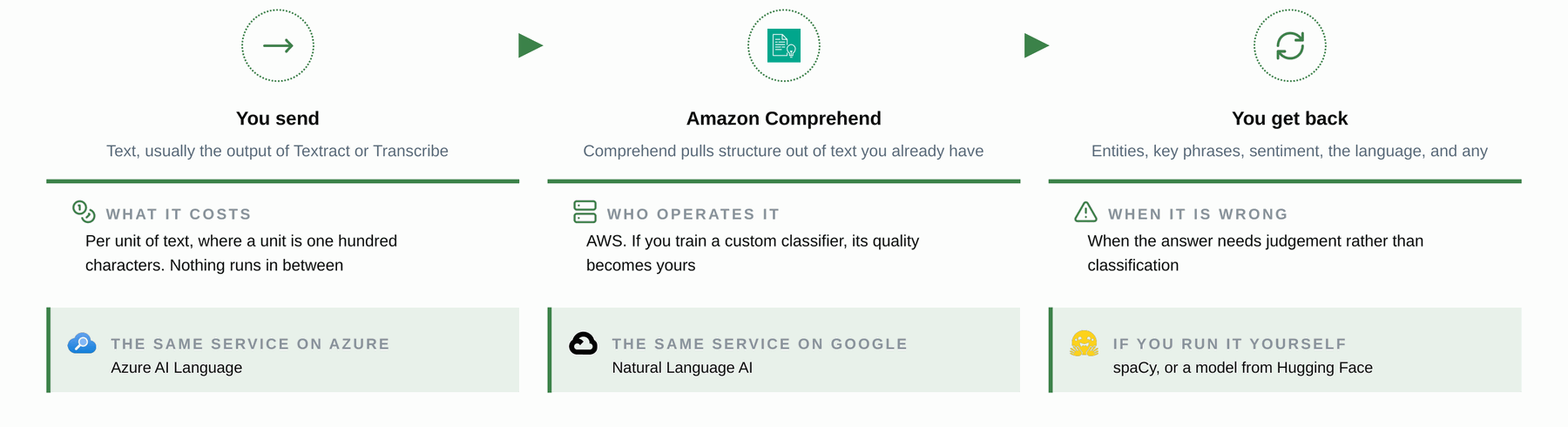
How it looks in an architecture
Slides from my course on AI architectures at FH Burgenland, drawn from real projects.
Where I used it
The geospatial platform
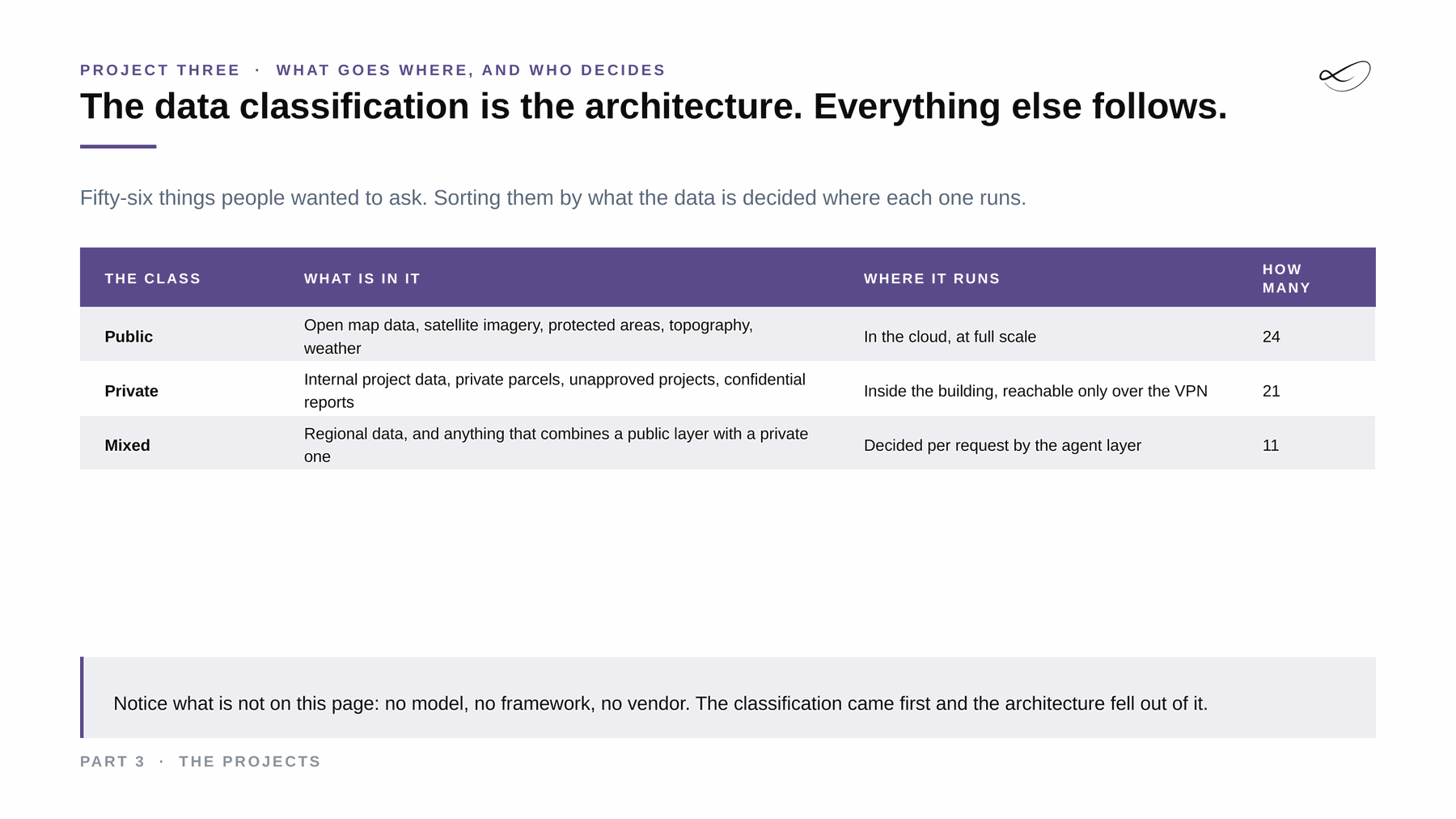
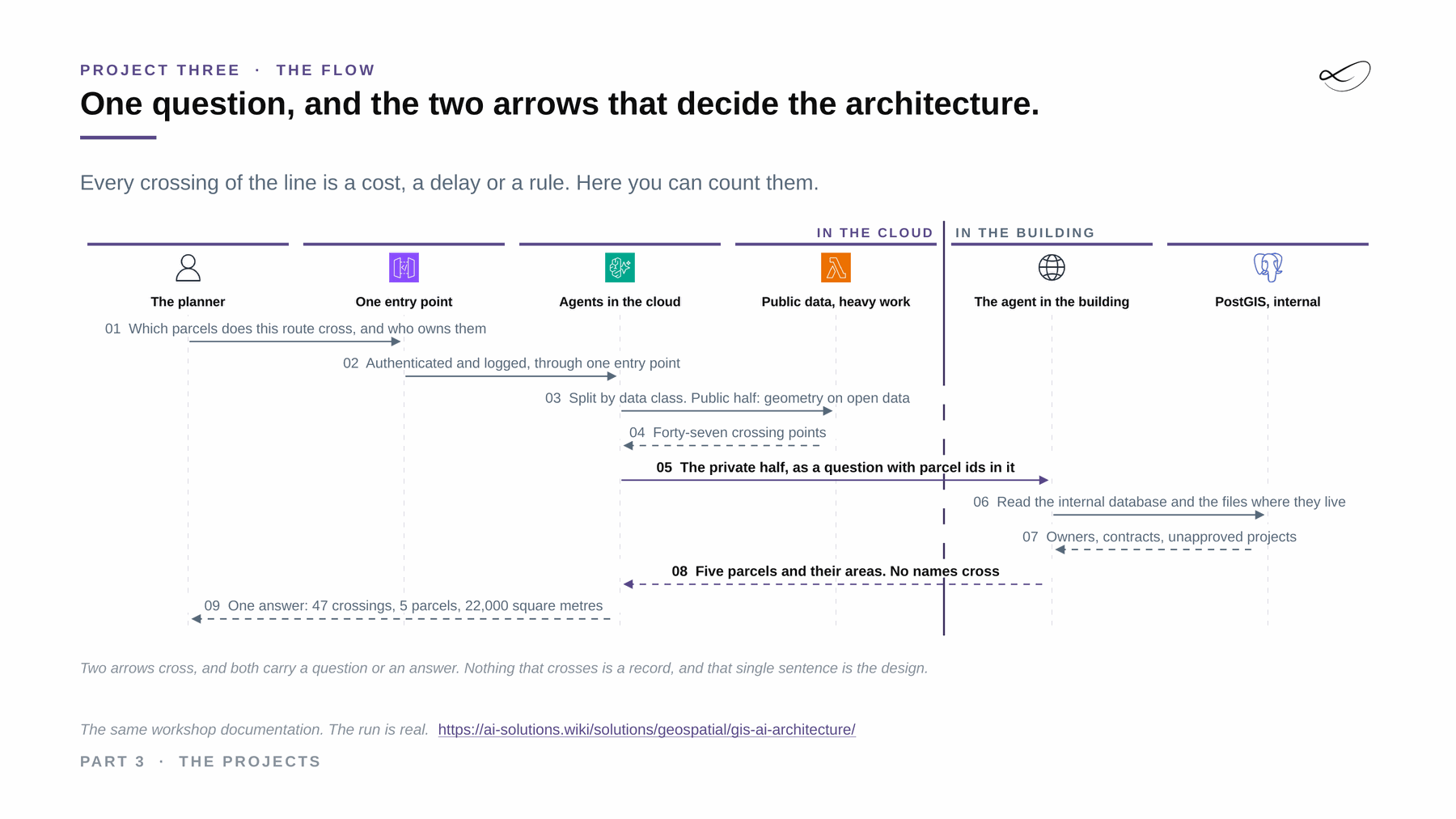
In my geospatial platform, sorting data into public, private and mixed was the first step and it decided the architecture. Private parcel data never crosses to the cloud: agents on both sides exchange a question and an answer, and no names cross.
Architecture on ai-solutions.wiki →Managed and self-hosted together: hybrid
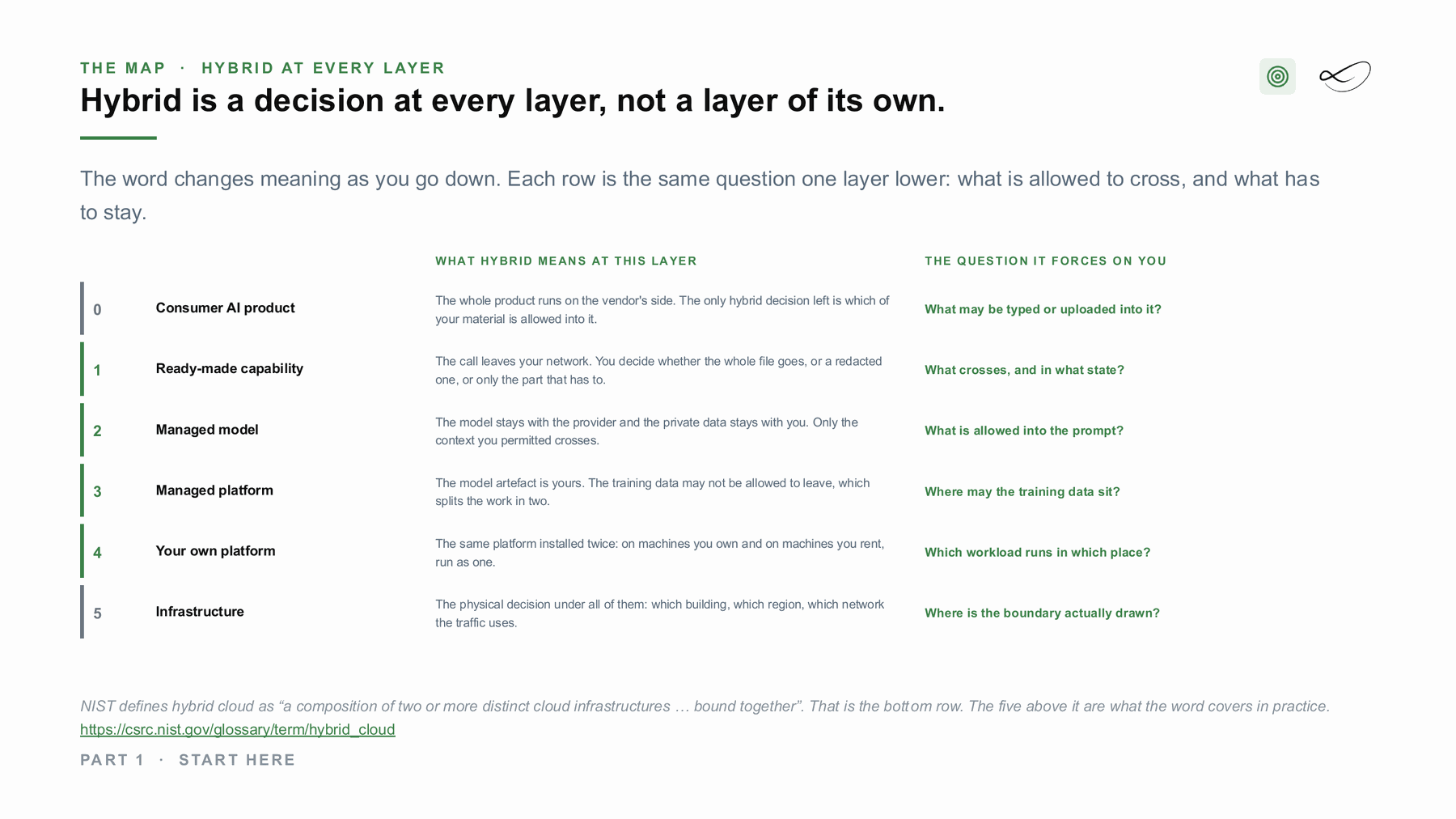
With a ready-made service the call leaves your network. The hybrid decision is what crosses, and in what state: the whole file, a redacted one, or only the part that has to. Where a file may not leave at all, the same step runs with the open-source option inside your building, and only the result, or nothing, crosses.[6]
What would help you next?
Learn to decide
The course “From Managed to Hybrid” teaches where AI should run: what each layer costs, what you operate and where your data has to stay. It is in preparation, with a free live session first.
 Linda Mohamed
AI and cloud consultant, AWS Community Hero, Vienna
Build it with me
Tell me what you want to build. In 30 minutes we check which of the four ways fits your data, your rules and your budget, and whether AWS funding for a proof of concept can cover part of it. How AWS funding works →
You already know what you need
Book the workshop directly:
- AI Concept and Prototype workshops →
Architecture first, priced per service and tested on your data, then a prototype with a go or stop decision. - AI Discovery Workshop →
Sort your ideas into a scored shortlist, so you know which use case to build first.

Read more on ai-solutions.wiki
My open knowledge base, with longer comparisons, pricing notes and sources.
Sources
- Amazon Comprehend documentation. https://docs.aws.amazon.com/comprehend/latest/dg/what-is.html
- Azure AI Language documentation. https://learn.microsoft.com/en-us/azure/ai-services/language-service/overview
- Natural Language AI documentation. https://cloud.google.com/natural-language/docs
- spaCy, or a model from Hugging Face. https://spacy.io/
- Linda Mohamed, course slides “The projects”, MASE-3, FH Burgenland, September 2026
- NIST glossary: hybrid cloud. https://csrc.nist.gov/glossary/term/hybrid_cloud
- Linda Mohamed, course slides “Start here”, MASE-3, FH Burgenland, September 2026
- Amazon Comprehend, ai-solutions.wiki. https://ai-solutions.wiki/tools/amazon-comprehend/
- spaCy, ai-solutions.wiki. https://ai-solutions.wiki/tools/spacy/
- Hugging Face, ai-solutions.wiki. https://ai-solutions.wiki/tools/huggingface/
- GIS and AI architecture on AWS, ai-solutions.wiki. https://ai-solutions.wiki/solutions/geospatial/gis-ai-architecture/
Links checked September 2026. Product names and features change: check the linked pages before you decide.