
Foundation models: one API in front of many large models
Large language models and other foundation models answer prompts: summarise, compare, classify, draft, explain. You choose the model and write the request; somebody runs the inference.


What are foundation models?
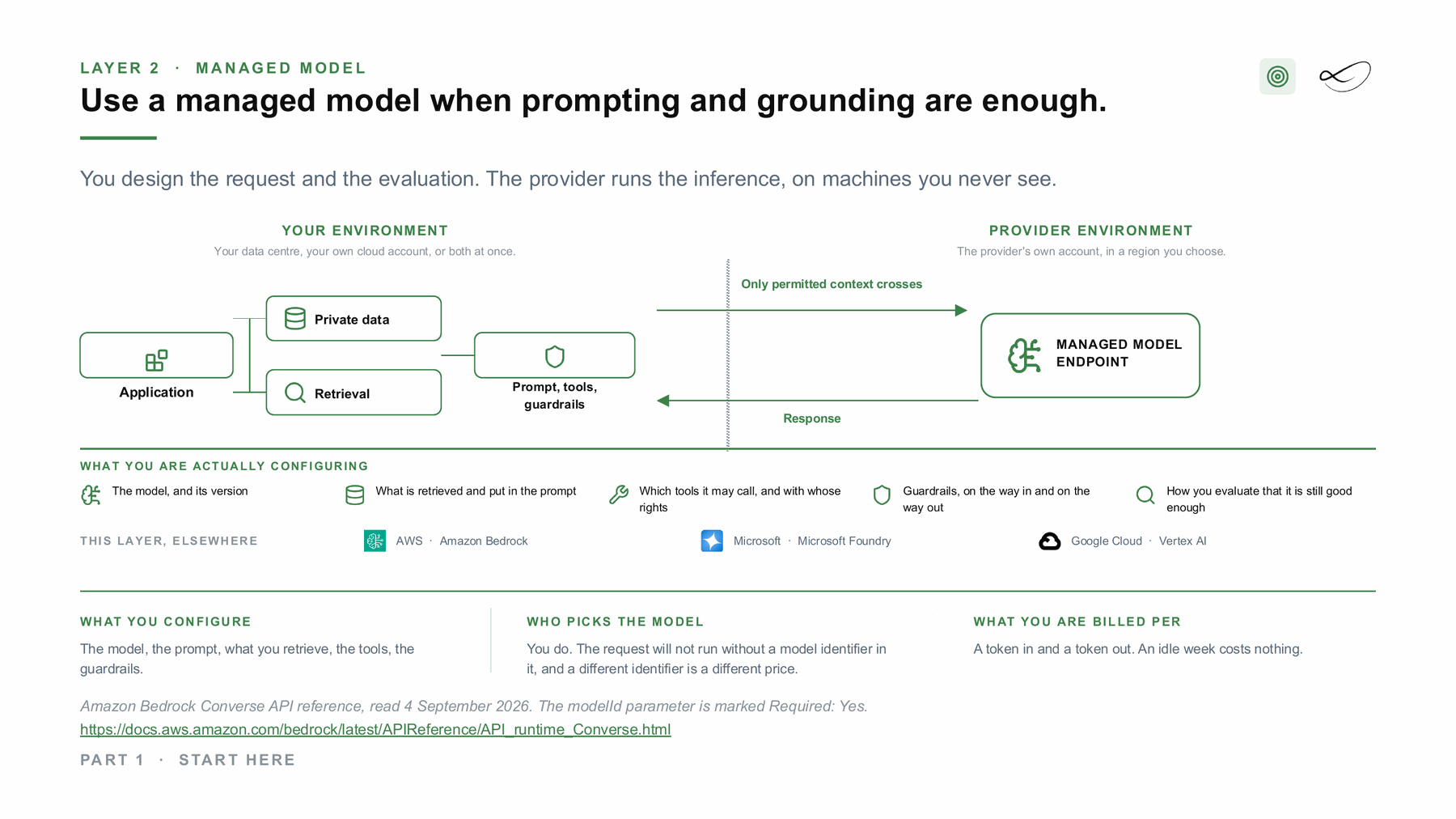
A foundation model is a large model trained on broad data, which you steer with a prompt instead of training it yourself. Managed platforms put many models from several providers behind one API, bill per token, and cost nothing when nobody asks.
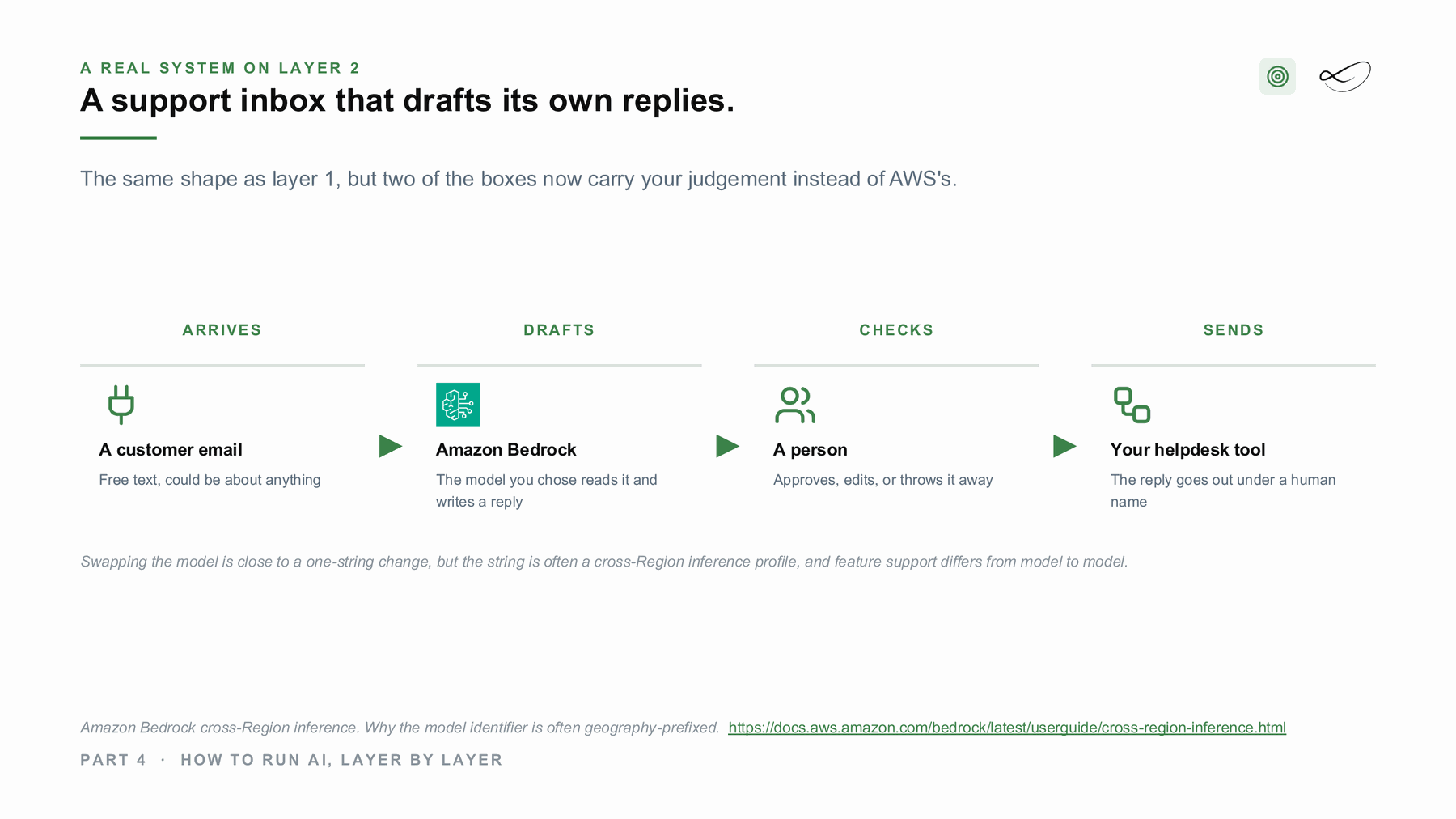
What you design is the request: which model, what context you retrieve and put in the prompt, which tools it may call, the guardrails, and how you check that the answers are still good enough. Swapping the model is close to a one-string change, and feature support still differs from model to model.
Four ways to run it
Each of the big clouds offers it as a managed service, and you can also run it yourself. Same task, a different bill and a different console.
Amazon Bedrock[1]
The managed foundation model service on AWS: models from several providers through one API, billed per token.
Official documentation →Microsoft Foundry[2]
The platform on Microsoft Azure for building with models and agents, renamed from Azure AI Foundry in November 2025.
Official documentation →Vertex AI[3]
The managed AI platform on Google Cloud, with Gemini and other models.
Official documentation →vLLM or Ollama[4]
Serving engines for open-weight models on your own GPU. vLLM (Apache 2.0) serves at scale with an OpenAI-compatible API; Ollama is the simplest way to run a model on one machine.
Project page →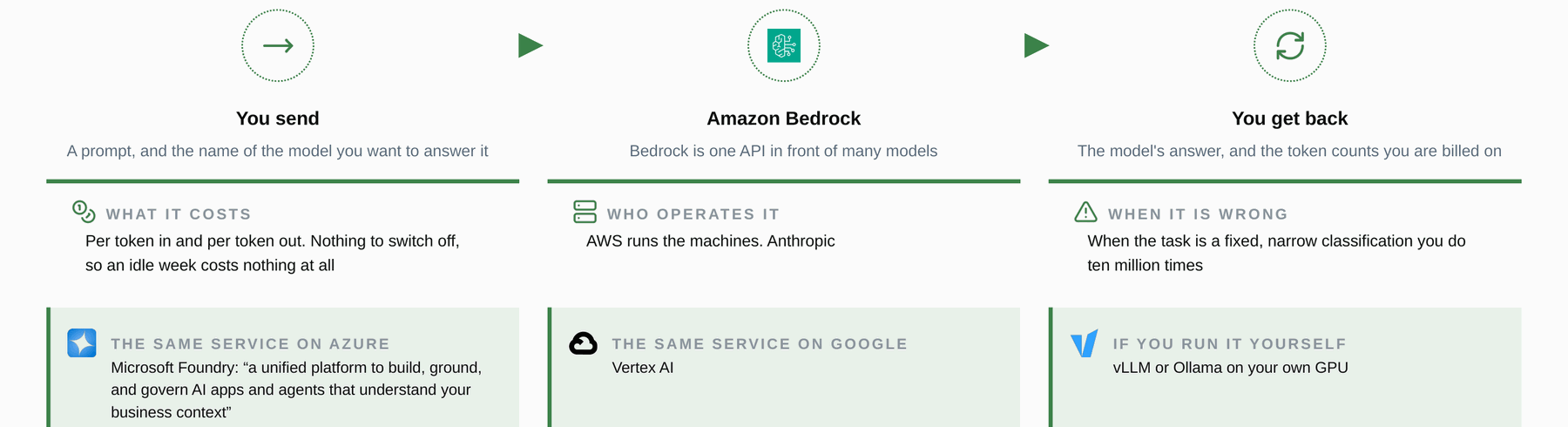
How it looks in an architecture
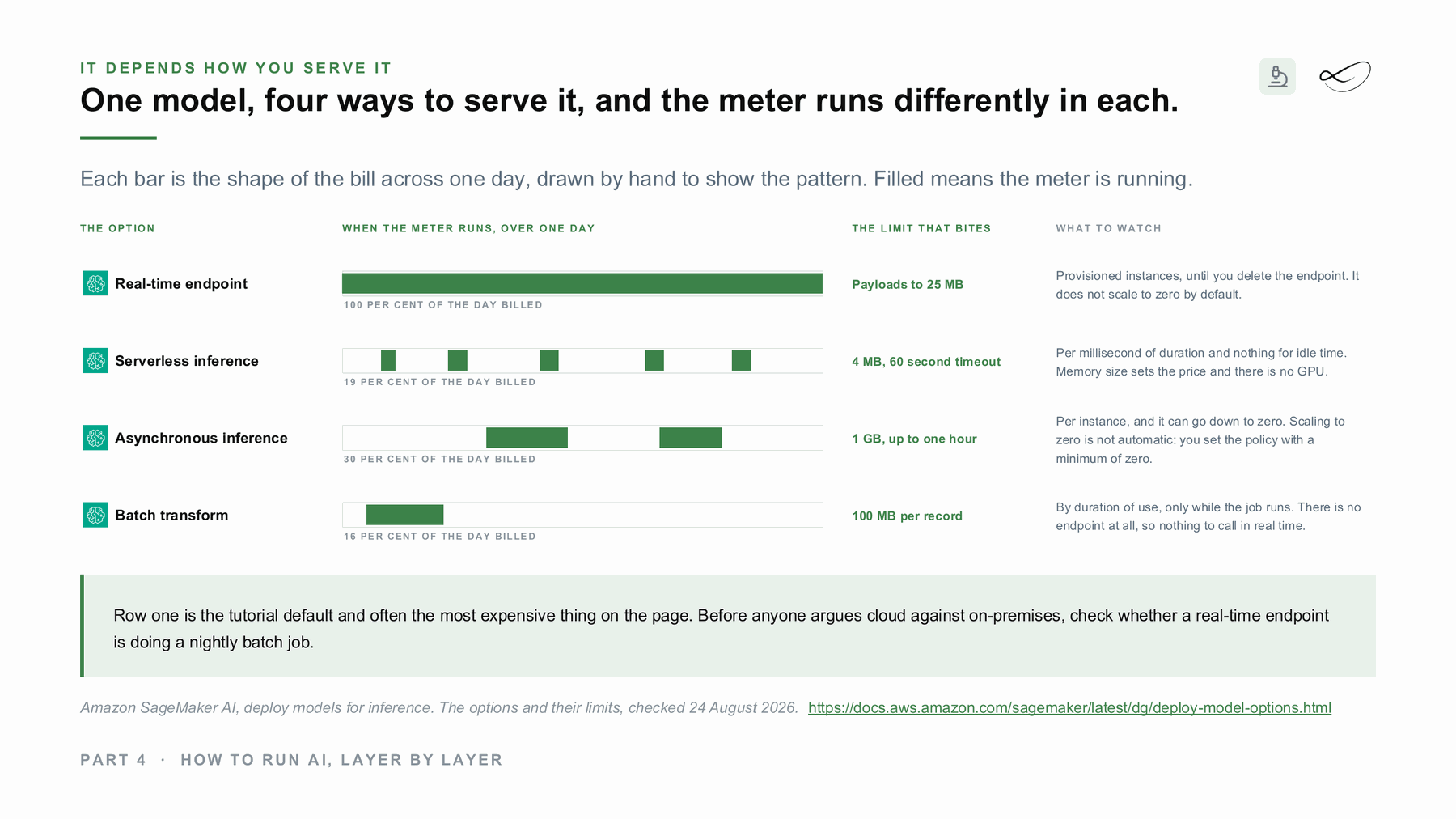
Slides from my course on AI architectures at FH Burgenland, drawn from real projects.
Where I used it
The video pipeline
In my video pipeline a model on Bedrock scores the candidate cuts, for about 5 cents a clip.
Read the write-up →The event assistant
In my event assistant, three of the six agents each have a different model behind them: Claude and Amazon Nova on Bedrock, and a small model I fine-tuned myself. Nothing about that is visible to the person asking.
See the reference projects →The geospatial platform
In my geospatial platform, Bedrock and AgentCore answer the public half of each question in the cloud. The private half never reaches a managed model.
Architecture on ai-solutions.wiki →Managed and self-hosted together: hybrid
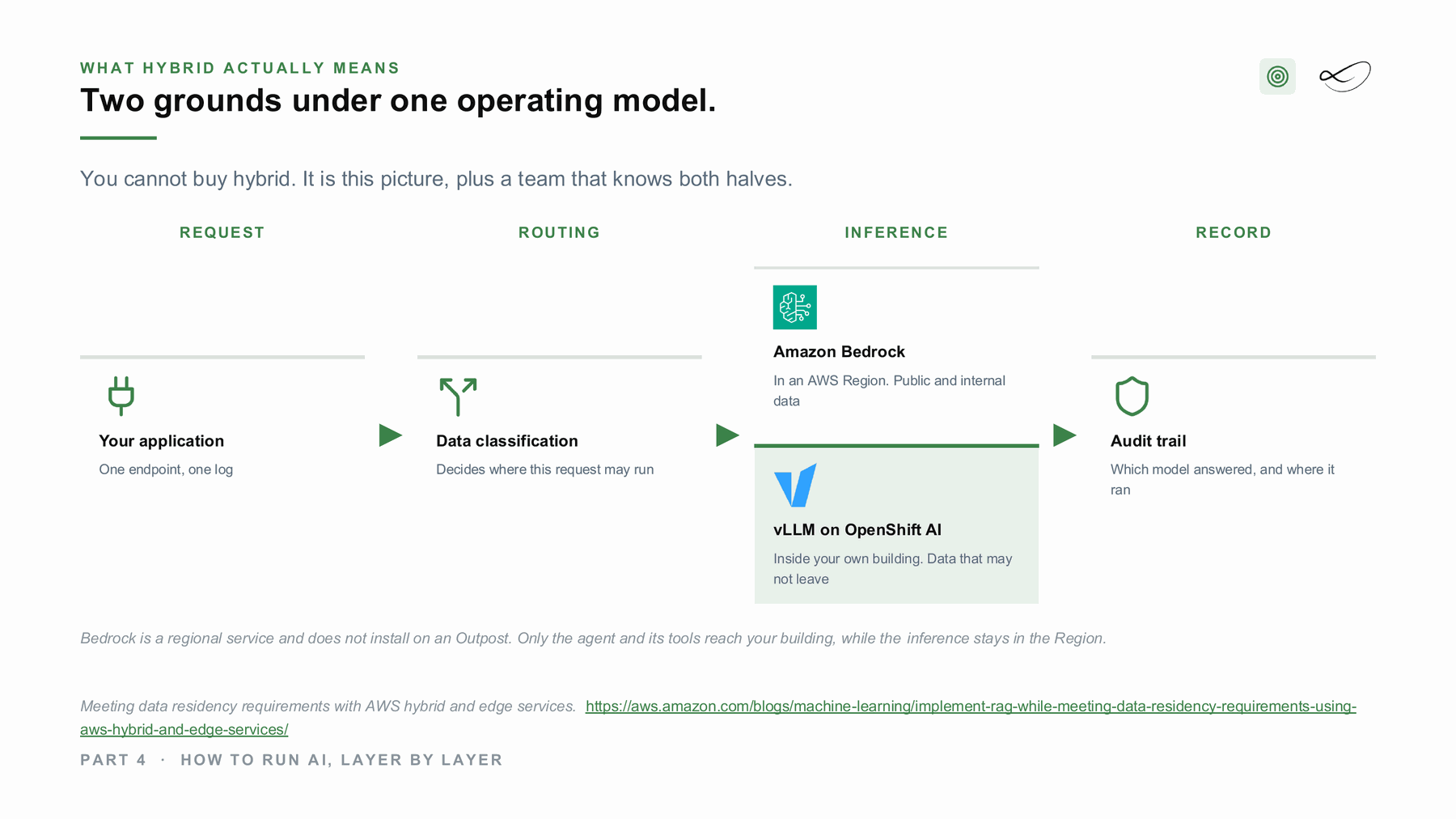
With a managed model, the model stays with the provider and your private data stays with you. Only the context you permitted crosses. Where data may not leave at all, a routing step classifies each request and sends it either to the managed model in a cloud region or to an open model on your own platform, for example vLLM on OpenShift AI, with one audit trail for both.[8]
What would help you next?
Learn to decide
The course “From Managed to Hybrid” teaches where AI should run: what each layer costs, what you operate and where your data has to stay. It is in preparation, with a free live session first.
 Linda Mohamed
AI and cloud consultant, AWS Community Hero, Vienna
Build it with me
Tell me what you want to build. In 30 minutes we check which of the four ways fits your data, your rules and your budget, and whether AWS funding for a proof of concept can cover part of it. How AWS funding works →
You already know what you need
Book the workshop directly:
- Generative AI Use Case Workshop →
Which GenAI ideas are worth building, and whether prompts, retrieval or fine-tuning fits each one. - AI Concept and Prototype workshops →
Architecture first, priced per service and tested on your data, then a prototype with a go or stop decision.

Read more on ai-solutions.wiki
My open knowledge base, with longer comparisons, pricing notes and sources.
Sources
- Amazon Bedrock documentation. https://docs.aws.amazon.com/bedrock/latest/userguide/what-is-bedrock.html
- Microsoft Foundry documentation. https://learn.microsoft.com/en-us/azure/foundry/what-is-foundry
- Vertex AI documentation. https://cloud.google.com/vertex-ai/docs
- vLLM or Ollama. https://docs.vllm.ai/
- Linda Mohamed, course slides “The projects”, MASE-3, FH Burgenland, September 2026
- Linda Mohamed, course slides “How to run AI, layer by layer”, MASE-3, FH Burgenland, September 2026
- Linda Mohamed, course slides “Start here”, MASE-3, FH Burgenland, September 2026
- Meeting data residency requirements with AWS hybrid and edge services, AWS Machine Learning Blog. https://aws.amazon.com/blogs/machine-learning/implement-rag-while-meeting-data-residency-requirements-using-aws-hybrid-and-edge-services/
- Amazon Bedrock, ai-solutions.wiki. https://ai-solutions.wiki/tools/amazon-bedrock/
- Amazon Bedrock vs Azure OpenAI, ai-solutions.wiki. https://ai-solutions.wiki/comparisons/bedrock-vs-azure-openai/
- vLLM, ai-solutions.wiki. https://ai-solutions.wiki/tools/vllm/
- Managed vs reserved vs self-hosted inference, ai-solutions.wiki. https://ai-solutions.wiki/comparisons/managed-vs-reserved-vs-self-hosted-inference/
Links checked September 2026. Product names and features change: check the linked pages before you decide.