Image recognition and object detection: what is in a picture
Computer vision models look at an image or a video frame and return what they see: objects, scenes, text or faces, each with a confidence value.


What are image recognition and object detection?
Image recognition answers “what is in this picture” with labels. Object detection goes one step further and also returns where each object is, as a box around it. Both work on single images and on frames taken out of a video.
Ready-made services know a large public set of labels. When your objects are not in anybody's public label set, you train on your own examples, either inside the managed service or with an open model on your own GPU.
Four ways to run it
Each of the big clouds offers it as a managed service, and you can also run it yourself. Same task, a different bill and a different console.
Amazon Rekognition[1]
The managed image and video analysis service on AWS. It returns labels, text and faces, and with Custom Labels it learns objects only your business cares about.
Official documentation →Azure AI Vision[2]
The managed computer vision service on Microsoft Azure for image analysis and reading text in images.
Official documentation →Cloud Vision API and Video Intelligence[3]
The managed image analysis API on Google Cloud, with a separate Video Intelligence API for video.
Official documentation →YOLO from Ultralytics[4]
A family of open object detection models you run on your own GPU. Ultralytics publishes it under AGPL-3.0, with an enterprise licence for closed products.
Project page →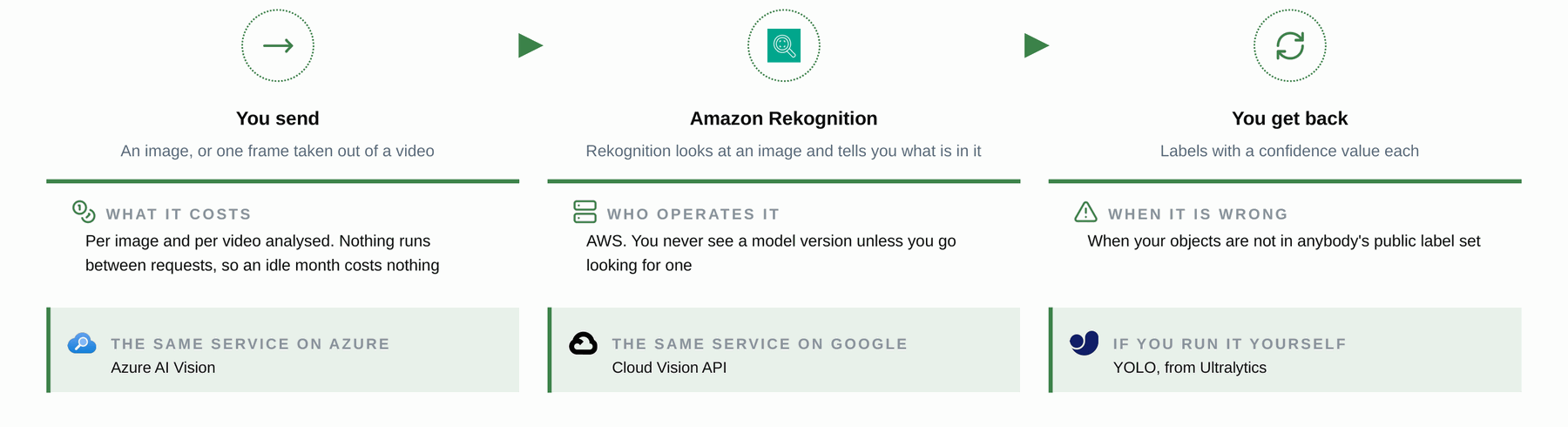
How it looks in an architecture
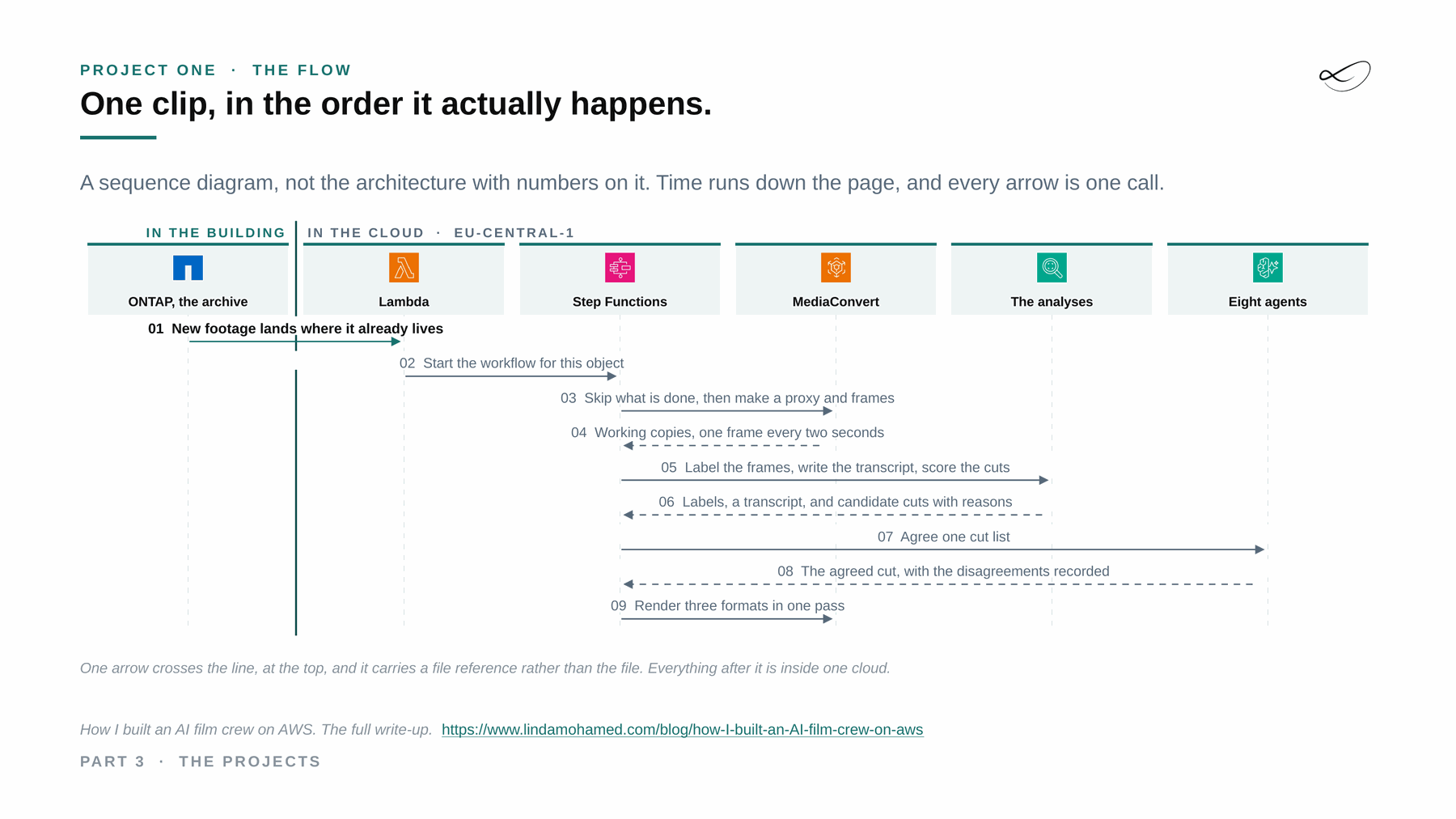
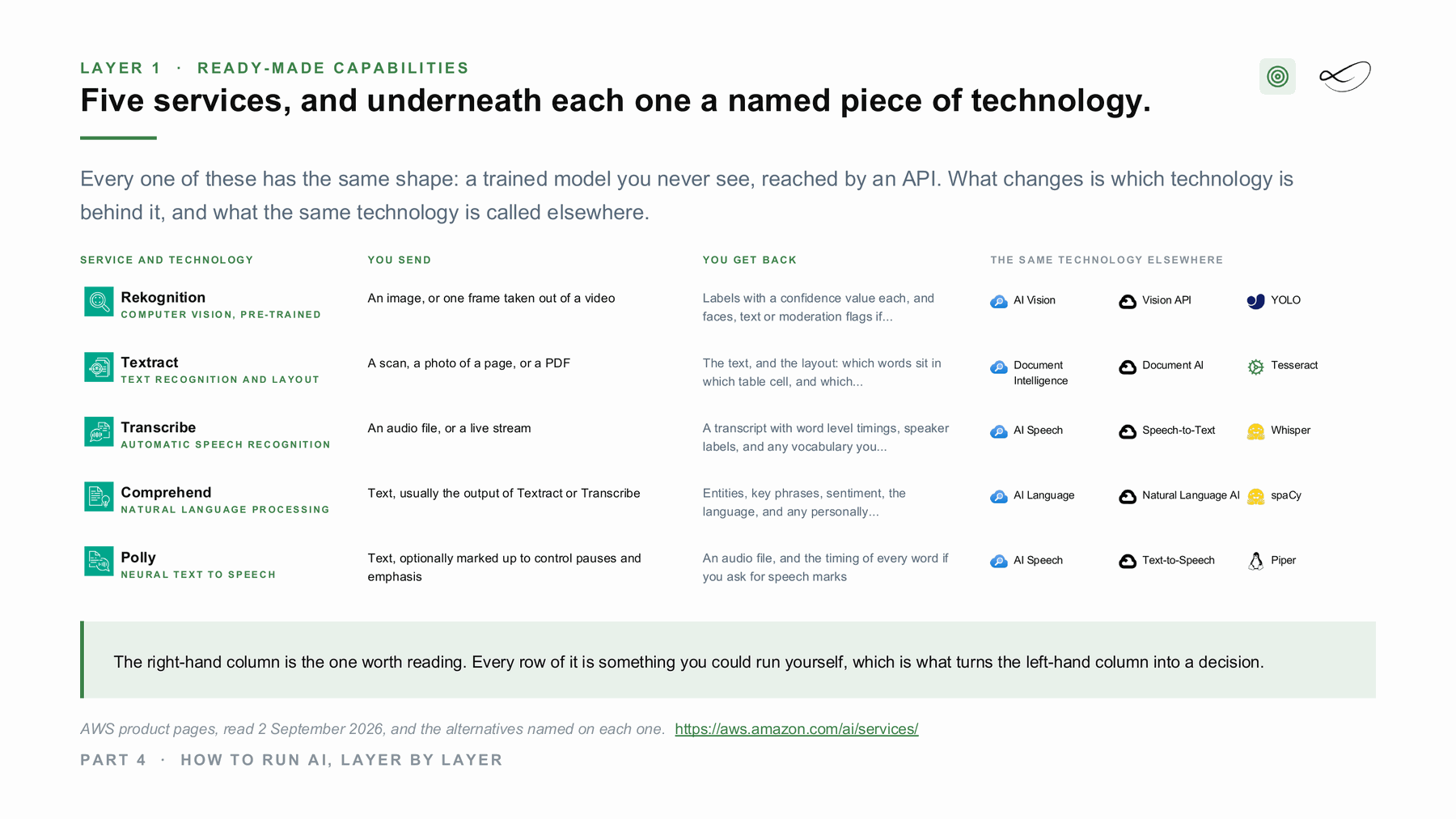
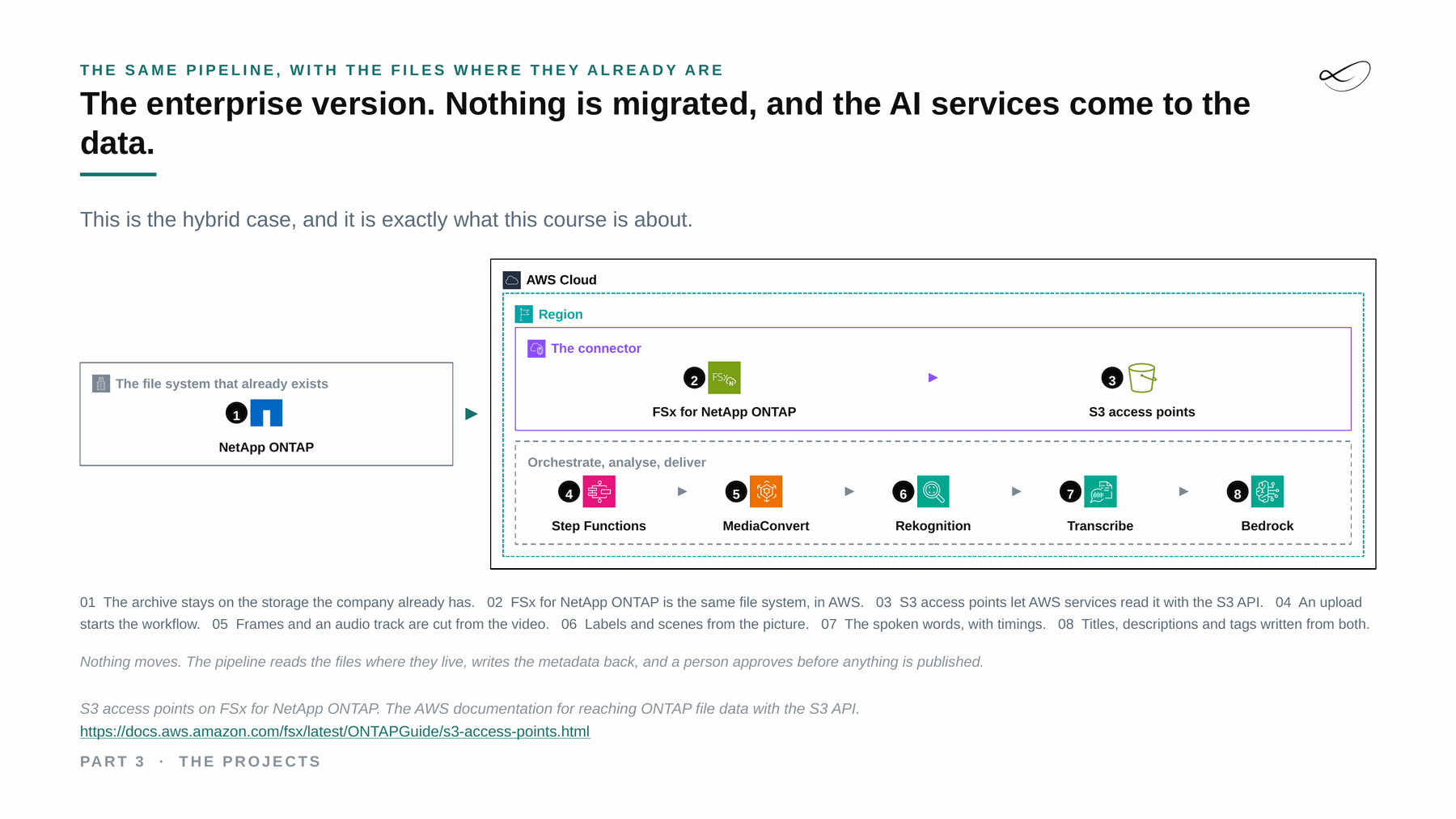
Slides from my course on AI architectures at FH Burgenland, drawn from real projects.
Where I used it
The video pipeline
In my video pipeline, Rekognition labels one frame every two seconds, for about 7 cents a clip. The labels are one of the inputs the agents use to decide which scenes make the cut.
Read the write-up →Managed and self-hosted together: hybrid
With a ready-made service the call leaves your network. The hybrid decision is what crosses, and in what state: the whole file, a redacted one, or only the part that has to. Where a file may not leave at all, the same step runs with the open-source option inside your building, and only the result, or nothing, crosses.[7]
What would help you next?
Learn to decide
The course “From Managed to Hybrid” teaches where AI should run: what each layer costs, what you operate and where your data has to stay. It is in preparation, with a free live session first.
 Linda Mohamed
AI and cloud consultant, AWS Community Hero, Vienna
Build it with me
Tell me what you want to build. In 30 minutes we check which of the four ways fits your data, your rules and your budget, and whether AWS funding for a proof of concept can cover part of it. How AWS funding works →
You already know what you need
Book the workshop directly:
- AI Concept and Prototype workshops →
Architecture first, priced per service and tested on your data, then a prototype with a go or stop decision. - AI Discovery Workshop →
Sort your ideas into a scored shortlist, so you know which use case to build first.

Read more on ai-solutions.wiki
My open knowledge base, with longer comparisons, pricing notes and sources.
Sources
- Amazon Rekognition documentation. https://docs.aws.amazon.com/rekognition/latest/dg/what-is.html
- Azure AI Vision documentation. https://learn.microsoft.com/en-us/azure/ai-services/computer-vision/overview
- Cloud Vision API and Video Intelligence documentation. https://cloud.google.com/vision/docs
- YOLO from Ultralytics. https://docs.ultralytics.com/
- Linda Mohamed, course slides “The projects”, MASE-3, FH Burgenland, September 2026
- Linda Mohamed, course slides “How to run AI, layer by layer”, MASE-3, FH Burgenland, September 2026
- S3 access points on FSx for NetApp ONTAP, AWS documentation. https://docs.aws.amazon.com/fsx/latest/ONTAPGuide/s3-access-points.html
- Amazon Rekognition, ai-solutions.wiki. https://ai-solutions.wiki/tools/amazon-rekognition/
- Azure Computer Vision, ai-solutions.wiki. https://ai-solutions.wiki/tools/azure-computer-vision/
- YOLO (Ultralytics), ai-solutions.wiki. https://ai-solutions.wiki/tools/yolo/
- Pre-built AI services vs foundation models, ai-solutions.wiki. https://ai-solutions.wiki/comparisons/prebuilt-ai-services-vs-foundation-models/
Links checked September 2026. Product names and features change: check the linked pages before you decide.